Quick Answer
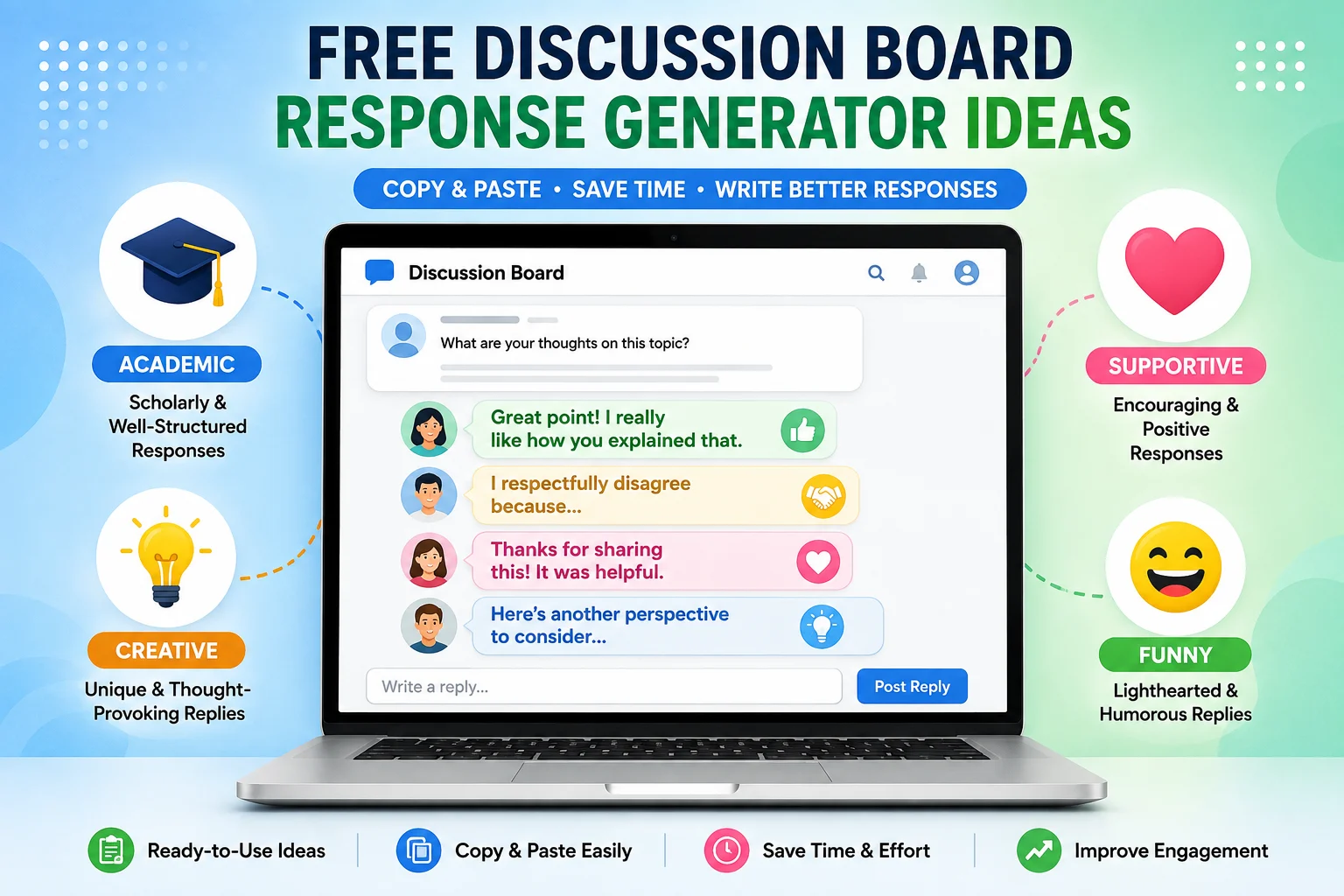
Need a solid reply for your online class forum, workplace thread, or community discussion? Stop staring at a blank box. A free discussion board response generator gives you ready-to-use phrases that sound thoughtful, engaged, and natural. You can adapt them to any topic in seconds.
Top 5 alternatives: “Great point! Here’s another angle to consider…”, “I appreciate your perspective and would add…”, “I respectfully disagree because…”, “This connects to something we covered earlier…”, “Can you clarify what you mean by…?”
We’ve all been there. It’s 11:47 PM. Your discussion board post is due at midnight. You’ve read three other students’ posts, and now you need to reply to at least two of them with something that actually sounds intelligent. Or maybe you’re on a professional forum, and you want to add value without rambling. The cursor blinks. Your brain buffers. You type “I agree” and delete it because it feels lazy.
Here’s the truth. Discussion board responses matter. They show your instructor you’re engaged. its show your colleagues you’re competent. A weak response can make you look uninterested or unprepared. A strong one can boost your grade, build your reputation, and spark real conversation. That’s why having a free discussion board response generator in your back pocket is so useful. Not a robot that writes for you, but a mental library of smart, adaptable phrases you can tweak for any topic.
This list gives you 150+ ready-to-use response starters, categorized by tone and situation. Whether you need to be polite, analytical, funny, or critical, you’ll find exactly what to say without sounding fake. Save this, bookmark it, and never panic at a discussion prompt again.
Academic Responses
“Your analysis of [topic] aligns with the course readings, particularly the point about [specific idea].”
Example: You want to show you’ve done the reading and connect your peer’s point to the material.
Meaning: You’re validating their argument while demonstrating your own preparation.
“I would extend your argument by considering [author’s name] perspective on this issue.”
Example: A classmate makes a good point, and you want to build on it with another source.
Meaning: You’re contributing depth without overshadowing their original idea.
“This reminds me of a concept we discussed in Week 3 regarding [concept].”
Example: You’re tying the current discussion back to earlier course content.
Meaning: You’re showing synthesis across the curriculum, which instructors love.
“Your post raises an important question about [issue]. I wonder how [theory] would explain this.”
Example: You want to introduce a theoretical lens without dismissing their point.
Meaning: You’re inviting further inquiry and showing critical thinking.
“I found your interpretation compelling, especially your emphasis on [detail].”
Example: You want to praise a specific part of their argument to show you read carefully.
Meaning: You’re giving targeted, sincere feedback rather than generic agreement.
“Based on the evidence you presented, it seems [conclusion]. Do you think [alternative] is also possible?”
Example: You’re engaging with their logic and offering a counterpoint for discussion.
Meaning: You’re demonstrating analytical thinking while keeping the dialogue open.
“Your post made me reconsider my initial position on [topic].”
Example: A peer’s argument is persuasive, and you want to acknowledge that.
Meaning: You’re showing intellectual humility and openness to new ideas.
“I’d like to add a historical context that might strengthen your point.”
Example: You have relevant background knowledge that supports their argument.
Meaning: You’re contributing additional evidence to elevate the discussion.
“While I agree with your overall conclusion, I think [counterpoint] deserves consideration.”
Example: You want to respectfully complicate a classmate’s viewpoint.
Meaning: You’re engaging critically while remaining collegial.
“Could you expand on what you meant by [specific phrase]? I want to make sure I understand.”
Example: A post is slightly vague, and you need clarification before responding fully.
Meaning: You’re showing active listening and a desire for precision.
“This discussion connects well with the assigned article by [author], particularly their point about [theme].”
Example: You want to reference course materials explicitly to earn participation credit.
Meaning: You’re demonstrating that you’ve integrated the readings into your thinking.
“Your post highlights a tension I’ve been noticing between [idea A] and [idea B].”
Example: You want to point out an interesting contradiction in the material.
Meaning: You’re elevating the conversation by identifying complexity.
Polite Responses
“Thank you for sharing your thoughts. I found your point about [topic] very insightful.”
Example: You want to open your response with a warm, respectful tone.
Meaning: You’re establishing a positive foundation for the discussion.
“I appreciate the time you took to write this. You made some excellent observations.”
Example: You’re replying to a long, well-developed post and want to acknowledge the effort.
Meaning: You’re showing respect for their contribution before adding your own.
“That’s a really interesting perspective. I hadn’t thought about it that way before.”
Example: You genuinely learned something new from their post.
Meaning: You’re validating their unique angle while being honest.
“You raise a valid point, and I’d like to add a slightly different view for consideration.”
Example: You disagree but want to cushion it with politeness.
Meaning: You’re maintaining civility while introducing a counterargument.
“I appreciate your honesty about [difficult topic]. It makes the discussion more meaningful.”
Example: Someone shares a personal or challenging perspective.
Meaning: You’re honoring their vulnerability and encouraging authenticity.
“Thanks for bringing up [specific issue]. It’s something we often overlook.”
Example: You want to acknowledge that they addressed a gap in the discussion.
Meaning: You’re showing that you value their contribution to the broader conversation.
“I respectfully see it a little differently, but I understand where you’re coming from.”
Example: You disagree but want to remain friendly and open.
Meaning: You’re balancing honesty with courtesy.
“Your post made me think more deeply about [topic]. Thank you for that.”
Example: You want to express genuine gratitude for intellectual stimulation.
Meaning: You’re reinforcing positive participation.
“I hope it’s okay to push back a little on your second point.”
Example: You’re about to challenge something and want to soften the approach.
Meaning: You’re seeking permission to disagree, which feels respectful.
“You’ve given me a lot to consider. I especially appreciated [specific part].”
Example: You want to highlight one strong aspect of their post before adding your thoughts.
Meaning: You’re balancing praise with your own contribution.
“Please let me know if I’m misreading your point, but I interpreted it as [your understanding].”
Example: You want to confirm your understanding before responding critically.
Meaning: You’re avoiding miscommunication and showing care.
“Thank you for starting this thread. It’s a topic that deserves more attention.”
Example: You’re replying to the original poster and want to show appreciation.
Meaning: You’re encouraging good discussion leadership.
Thoughtful Responses
“Your post made me pause and reflect on my own assumptions about [topic].”
Example: You want to show that their writing had a real impact on you.
Meaning: You’re demonstrating depth and self-awareness.
“I keep coming back to your point about [specific idea]. It resonates for several reasons.”
Example: You want to indicate that their argument lingered in your mind.
Meaning: You’re showing that their words had staying power.
“This raises a deeper question: [philosophical or ethical question].”
Example: You want to push the conversation toward bigger implications.
Meaning: You’re elevating the discussion from surface level to meaningful.
“I wonder if we’re asking the right question here. What if we reframed it as [new question]?”
Example: You think the discussion is slightly off track and want to redirect.
Meaning: You’re offering a new lens without dismissing what’s been said.
“Your post reminded me of a personal experience that shaped my view on this.”
Example: You want to connect the academic topic to your own life.
Meaning: You’re adding authenticity and showing real-world relevance.
“I’ve been sitting with this topic for a while, and your post clarified something for me.”
Example: A peer’s explanation helped you understand a confusing concept.
Meaning: You’re crediting them with aiding your comprehension.
“There’s a subtle but important distinction here that I think we should explore.”
Example: You notice a nuance in the discussion that others missed.
Meaning: You’re drawing attention to complexity and encouraging precision.
“I’m still working through my thoughts on this, but your post gave me a starting point.”
Example: You’re not fully formed in your opinion but want to engage anyway.
Meaning: You’re showing honesty about your process while participating.
“This topic feels especially relevant right now given [current event or trend].”
Example: You want to connect the discussion to the real world.
Meaning: You’re making the conversation timely and urgent.
“I appreciate that you didn’t oversimplify this. It’s more layered than it seems.”
Example: Someone treated a complex issue with appropriate nuance.
Meaning: You’re praising their intellectual honesty.
“Your post challenged me to think beyond my usual framework. That’s rare and valuable.”
Example: You want to express that their argument genuinely changed your perspective.
Meaning: You’re giving high praise for intellectual impact.
“I’m left wondering about the implications of this for [related area].”
Example: You want to extend the discussion to adjacent topics.
Meaning: You’re showing curiosity and forward thinking.
Critical Responses
“I see your point, but I’m not entirely convinced because [specific reason].”
Example: You have a genuine counterargument and want to present it clearly.
Meaning: You’re disagreeing without being dismissive.
“While I understand your logic, I think there’s an important factor you may have overlooked.”
Example: You’ve identified a gap in their reasoning.
Meaning: You’re pointing out a flaw while acknowledging their effort.
“I’d challenge the assumption that [underlying premise]. Could we examine that more closely?”
Example: You think the foundation of their argument is shaky.
Meaning: You’re redirecting attention to the root of the disagreement.
“Your conclusion doesn’t necessarily follow from your evidence. Here’s why.”
Example: You want to explain a logical fallacy or weak inference.
Meaning: You’re engaging in rigorous debate.
“I respectfully disagree. My reading of the evidence leads me to a different conclusion.”
Example: You’ve analyzed the same material and came to a different result.
Meaning: You’re showing that disagreement can be based on legitimate differences.
“There’s a potential contradiction in your argument that I’d like to explore.”
Example: You notice an inconsistency in their reasoning.
Meaning: You’re inviting them to clarify or revise their position.
“I think this perspective underestimates the role of [important factor].”
Example: You believe they’ve ignored a crucial variable.
Meaning: You’re adding a missing piece to the analysis.
“Have you considered the counterargument that [opposing view]?”
Example: You want to test whether they’ve thought through alternatives.
Meaning: You’re encouraging intellectual thoroughness.
“I’m not sure the data supports that claim. Could you share where you found that?”
Example: You suspect a factual error or unsupported assertion.
Meaning: You’re asking for evidence without accusing them of lying.
“While I agree with part of your post, I think the conclusion overreaches.”
Example: You find their argument partially correct but too broad.
Meaning: You’re offering balanced criticism.
“This is a strong argument, but it rests on a debatable assumption that we should address.”
Example: You want to acknowledge their strength while challenging a weak point.
Meaning: You’re being fair while still pushing back.
“I think there’s a more nuanced position between your view and the opposite extreme.”
Example: You think the discussion has become too polarized.
Meaning: You’re advocating for complexity and middle ground.
Supportive Responses
“This is such an important point. I’m glad you brought it up.”
Example: A classmate addresses something that needed to be said.
Meaning: You’re validating their contribution and encouraging more.
“I really appreciated the example you used. It made the concept much clearer for me.”
Example: They explained something with a helpful illustration.
Meaning: You’re giving specific praise that shows you paid attention.
“You articulated something I’ve been thinking but couldn’t put into words.”
Example: Their post captured a feeling you shared but hadn’t expressed.
Meaning: You’re showing solidarity and appreciation.
“Your perspective adds a lot to this discussion. Thank you for sharing.”
Example: You want to encourage someone who offered a unique viewpoint.
Meaning: You’re reinforcing their value to the group.
“I found your post really helpful for understanding [difficult topic].”
Example: Someone explained a confusing concept in an accessible way.
Meaning: You’re crediting them with aiding your learning.
“This is a great point that I think many of us were missing.”
Example: You want to highlight that their contribution filled a gap.
Meaning: You’re elevating their idea for the whole group.
“You handled a sensitive topic with a lot of care. That’s not easy to do.”
Example: Someone discussed a controversial issue respectfully.
Meaning: You’re praising their emotional intelligence.
“I loved the way you connected [idea A] to [idea B]. It clicked for me.”
Example: They made a link between concepts that you found illuminating.
Meaning: You’re showing that their synthesis was effective.
“Thanks for pushing the conversation in this direction. It’s exactly what we needed.”
Example: You want to affirm that their contribution improved the discussion.
Meaning: You’re encouraging leadership and initiative.
“Your post was one of the most thoughtful I’ve read on this topic.”
Example: You’re genuinely impressed by their analysis.
Meaning: You’re giving high praise to boost their confidence.
“I’m grateful you shared this because it’s helping me think more clearly.”
Example: Their post clarified your own thinking.
Meaning: You’re expressing gratitude for intellectual assistance.
“You’re absolutely right, and I don’t think enough people are saying this.”
Example: They made an unpopular but correct point.
Meaning: You’re validating their courage and accuracy.
Funny Responses
“I was going to write a long reply, but then I realized you said everything I wanted to say. So… ditto, but with more words.”
Example: You agree completely but want to add humor to the thread.
Meaning: You’re acknowledging agreement while being playful about the redundancy.
“This post is so good I’m considering citing it in my next paper.”
Example: You want to praise someone’s contribution in a funny way.
Meaning: You’re exaggerating to show how much you valued their post.
“I came here to disagree, but you’ve left me with no argument. Rude.”
Example: You expected to debate but found their post unassailable.
Meaning: You’re humorously admitting defeat.
“My brain is still loading a response. Check back in an hour.”
Example: The topic is complex, and you need time to process.
Meaning: You’re using tech humor to buy time.
“I’d add something insightful, but I’m pretty sure you covered every possible angle.”
Example: You want to respond but have nothing new to contribute.
Meaning: You’re praising their thoroughness with self-deprecating humor.
“This is the kind of post that makes me feel like I need to go read three more books.”
Example: Their post was so smart it made you feel underprepared.
Meaning: You’re giving a backhanded compliment that’s actually sincere.
“My keyboard and I are having a disagreement about how to respond to this.”
Example: You’re struggling to articulate a response.
Meaning: You’re making your writer’s block funny.
“I was going to say ‘I agree,’ but you’ve raised the bar too high. Give me a minute.”
Example: You want to respond meaningfully but feel pressured by their quality.
Meaning: You’re acknowledging their standard with humor.
“This post should come with a warning: may cause excessive head nodding.”
Example: You found yourself agreeing with everything they said.
Meaning: You’re expressing strong agreement in a lighthearted way.
“I’d argue, but then I’d lose, and my ego is fragile today.”
Example: You see no flaws in their argument and don’t want to debate.
Meaning: You’re humorously conceding without actually arguing.
“I tried to find something to disagree with. I failed. Congratulations.”
Example: You searched for a counterpoint and couldn’t find one.
Meaning: You’re praising their logic with playful defeat.
“This post is going straight into my ‘smart things people said’ folder.”
Example: You want to remember their insight.
Meaning: You’re showing appreciation with a quirky, memorable image.
Sarcastic Responses
“Oh great, another well-reasoned post that leaves me nothing to add. Thanks a lot.”
Example: You’re feigning annoyance at their thoroughness.
Meaning: You’re actually praising them while pretending to be inconvenienced.
“I was hoping for a weak argument so I could easily respond. Guess I’ll have to think now.”
Example: You expected a simple post but got a complex one.
Meaning: You’re sarcastically complaining about the effort required to respond.
“This discussion board really needed another perfect post. We were running low.”
Example: You’re joking that the thread already has many good posts.
Meaning: You’re sarcastically acknowledging their high-quality contribution.
“I’m so glad I read this instead of doing literally anything else.”
Example: The post was actually very valuable, and you want to joke about it.
Meaning: You’re using sarcasm to highlight that it was time well spent.
“Wow, you really left no room for discussion. How inconsiderate.”
Example: Their post was so comprehensive that it ended the debate.
Meaning: You’re humorously pretending to be upset about their thoroughness.
“I was going to write a thoughtful reply, but you’ve made it impossible. I’ll just nod silently.”
Example: You can’t add anything new to their argument.
Meaning: You’re sarcastically admitting defeat while praising them.
“Thanks for making the rest of us look bad with your eloquence.”
Example: Their writing was exceptionally good, and you want to tease them.
Meaning: You’re giving a backhanded compliment that’s mostly sincere.
“This post is so logical it hurts. My emotions are filing a complaint.”
Example: You’re joking that their argument is too rational to counter.
Meaning: You’re acknowledging their strength with exaggerated frustration.
“I’d love to engage with this, but I’m still recovering from how right you are.”
Example: You need time to process their compelling argument.
Meaning: You’re sarcastically delaying your response due to their quality.
“Could you be a little less convincing? I had a whole counterargument planned.”
Example: You wanted to disagree but their post changed your mind.
Meaning: You’re humorously blaming them for your change of heart.
“This discussion was supposed to be easy. Now I have to actually think. Unacceptable.”
Example: Their post raised the intellectual stakes of the thread.
Meaning: You’re joking that they made the discussion harder.
“I’m going to pretend I didn’t read this so I can still feel smart.”
Example: Their post made you realize how much you didn’t know.
Meaning: You’re using self-deprecating sarcasm to compliment them.
Professional Responses
“Thank you for the detailed breakdown. I’d like to add a point from our last team meeting.”
Example: You’re on a work forum and want to connect the discussion to internal context.
Meaning: You’re bridging the online discussion with real-world work.
“I appreciate the thoroughness of your analysis. One consideration we might explore further is [specific area].”
Example: You want to build on a colleague’s post in a professional setting.
Meaning: You’re adding value while respecting their contribution.
“This aligns well with the project goals we outlined last quarter.”
Example: You want to show that the discussion is relevant to organizational objectives.
Meaning: You’re connecting individual insights to team strategy.
“I’d like to offer a slightly different perspective based on my experience with [relevant project].”
Example: You have firsthand knowledge that contradicts or complicates the post.
Meaning: You’re respectfully introducing experiential evidence.
“Thank you for raising this. It’s a timely topic given our current priorities.”
Example: You want to affirm that the post is relevant to immediate work.
Meaning: You’re validating their contribution in a professional context.
“I agree with the overall direction. Let’s schedule a follow-up to discuss implementation.”
Example: The post suggests a good idea, and you want to move toward action.
Meaning: You’re showing initiative and practicality.
“This is a useful starting point. I’d recommend we also consider [additional factor] before finalizing.”
Example: You’re contributing to a decision-making discussion.
Meaning: You’re adding caution and thoroughness without dismissing their work.
“Thanks for documenting this. It will be a helpful reference for the team.”
Example: Someone shared useful information or a summary.
Meaning: You’re acknowledging their contribution to team knowledge.
“I see this from a slightly different angle, but I think our goals are aligned.”
Example: You disagree on approach but not on objectives.
Meaning: You’re finding common ground while noting differences.
“This is an important conversation. I’d like to hear more from other team members as well.”
Example: You want to encourage broader participation.
Meaning: You’re facilitating inclusive discussion.
“Your post addresses a key risk we need to manage. Thank you for flagging it.”
Example: Someone raised a concern that others missed.
Meaning: You’re validating their contribution to risk management.
“I’d like to add a data point that supports your conclusion.”
Example: You have evidence that strengthens their argument.
Meaning: You’re building on their work with additional support.
Creative Responses
“If this topic were a movie, your post would be the plot twist everyone talks about.”
Example: You want to praise their unexpected perspective in a memorable way.
Meaning: You’re using metaphor to make your appreciation stand out.
“Your post is like a key that unlocked a door in my thinking.”
Example: They helped you understand something in a new way.
Meaning: You’re using imagery to express gratitude for their insight.
“I’m going to print your post and hang it on my wall. It’s that good.”
Example: You want to exaggerate your appreciation for effect.
Meaning: You’re showing extreme praise with humor.
“This is the kind of response that makes discussion boards worth reading.”
Example: You want to highlight that their post elevated the whole forum.
Meaning: You’re giving a broad compliment about their contribution.
“I’d like to add a verse to your post, like a remix.”
Example: You want to build on their idea with a creative addition.
Meaning: You’re using music terminology to frame your contribution as collaborative.
“Your post sent my brain on a little adventure. Thank you for the trip.”
Example: Their writing sparked many new thoughts and connections.
Meaning: You’re expressing that their post stimulated your imagination.
“If ideas were colors, your post would be a rainbow in a gray thread.”
Example: You want to contrast their vibrant thinking with the dullness of others.
Meaning: You’re using vivid imagery to praise their originality.
“I’m stealing your phrase ‘[specific phrase]’ for my own vocabulary. It’s too good.”
Example: They used a clever turn of phrase you want to remember.
Meaning: You’re flattering them by wanting to adopt their language.
“This post is like a Swiss Army knife: it has a tool for every part of the discussion.”
Example: Their post addressed multiple facets of the topic.
Meaning: You’re praising their comprehensiveness with a creative analogy.
“I was going to write a response, but your post already did a mic drop.”
Example: Their conclusion was so strong it ended the discussion.
Meaning: You’re using a cultural reference to show they finished the debate.
“Your post turned this discussion board into a TED Talk.”
Example: Their writing was inspiring and well-structured.
Meaning: You’re elevating their contribution by comparing it to a professional talk.
“I’m bookmarking this thread just so I can reread your post when I need a brain boost.”
Example: You want to save their insight for future reference.
Meaning: You’re showing that their words have lasting value to you.
Debating Responses
“I understand your position, but let me offer a counterexample that might complicate things.”
Example: You have a specific case that challenges their argument.
Meaning: You’re engaging in rigorous debate by introducing contrary evidence.
“Your argument rests on a premise I think we should examine more closely.”
Example: You want to question the foundation of their reasoning.
Meaning: You’re focusing the debate on underlying assumptions.
“I’d like to push back on one point you made. It doesn’t align with [source or data].”
Example: You have evidence that contradicts a specific claim.
Meaning: You’re introducing factual disagreement into the discussion.
“While your conclusion is plausible, there’s an alternative explanation we should consider.”
Example: You think they jumped to a conclusion too quickly.
Meaning: You’re offering a different interpretation of the evidence.
“I see several strengths in your argument, but also some weaknesses I’d like to explore.”
Example: You want to give a balanced assessment before disagreeing.
Meaning: You’re being fair while still engaging critically.
“Could you defend your position against the objection that [common counterargument]?”
Example: You want to see if they’ve considered a standard rebuttal.
Meaning: You’re testing the robustness of their argument.
“I agree with your first point but not your second. Here’s why.”
Example: You want to be precise about where you diverge.
Meaning: You’re showing nuanced engagement rather than blanket agreement or disagreement.
“This reminds me of a debate in [field] about [similar issue]. I think the same principles apply here.”
Example: You’re drawing a parallel to an established academic debate.
Meaning: You’re contextualizing the discussion within a larger intellectual tradition.
“I’d like to propose a third option that combines elements of both our positions.”
Example: You see a way to synthesize competing viewpoints.
Meaning: You’re moving the debate toward resolution or complexity.
“Your argument assumes [X], but what if [Y] is actually the case?”
Example: You want to challenge a hidden premise.
Meaning: You’re exposing an unexamined assumption in their reasoning.
“I’m not convinced by the evidence you cited. Could you explain how it supports your claim?”
Example: You think their evidence doesn’t actually prove their point.
Meaning: You’re asking them to connect the dots more clearly.
“Let’s steelman your argument and see if it holds up.”
Example: You want to give their position the strongest possible interpretation before testing it.
Meaning: You’re showing intellectual charity and rigor.
Clarifying Responses
“Could you elaborate on what you meant by [specific term or phrase]?”
Example: A post uses jargon or an ambiguous term, and you need clarity.
Meaning: You’re asking for explanation to avoid misunderstanding.
“I want to make sure I understand your main point. Are you saying that [your interpretation]?”
Example: You’re paraphrasing their argument to confirm accuracy.
Meaning: You’re practicing active listening and preventing miscommunication.
“When you say [X], do you mean [interpretation A] or [interpretation B]?”
Example: A statement could be read two ways, and you want to pin it down.
Meaning: You’re seeking precision to respond appropriately.
“Can you provide an example to illustrate your point? It would help me understand better.”
Example: Their argument is abstract and needs concrete illustration.
Meaning: You’re asking for clarification in a respectful, helpful way.
“I’m not familiar with [term or concept]. Could you explain it briefly?”
Example: They used a specialized term you don’t know.
Meaning: You’re being honest about your knowledge gap and asking for help.
“I think I follow, but I’m confused about how this connects to [earlier point].”
Example: You see a logical jump that isn’t clear.
Meaning: You’re identifying a gap in the reasoning and asking for connection.
“Could you clarify the scope of your argument? Does it apply to all cases or only specific ones?”
Example: Their claim seems too broad, and you want to know its limits.
Meaning: You’re testing the boundaries of their assertion.
“I’m not sure I understand the relevance of [detail]. Could you explain its role in your argument?”
Example: They included information that seems unrelated to the main point.
Meaning: You’re asking them to justify the inclusion of certain evidence.
“When you say this, are you speaking from personal experience or citing a source?”
Example: You need to know the basis of their claim.
Meaning: You’re asking for the evidentiary foundation of their statement.
“I’d like to understand your position better before responding fully.”
Example: You want to avoid misrepresenting their view.
Meaning: You’re prioritizing accurate understanding over quick reaction.
“Could you explain how you arrived at that conclusion? I’m interested in your reasoning.”
Example: You want to see the logical steps they took.
Meaning: You’re inviting them to walk through their thought process.
“Are you arguing for [X] or just presenting it as a possibility?”
Example: Their post is ambiguous about their stance.
Meaning: You’re asking them to commit to a position or clarify their intent.
Brief Responses
“Well said.”
Example: You agree completely and don’t need to add anything.
Meaning: You’re giving concise, sincere praise.
“I agree with this.”
Example: You want to register your agreement without elaboration.
Meaning: You’re signaling support with minimal words.
“This is a key point.”
Example: You want to highlight the importance of their statement.
Meaning: You’re emphasizing relevance without expanding.
“Interesting perspective.”
Example: You find their view thought-provoking but aren’t ready to engage deeply.
Meaning: You’re acknowledging their post without committing to agreement.
“I hadn’t thought of that.”
Example: They introduced a new angle you hadn’t considered.
Meaning: You’re admitting you learned something.
“Good catch.”
Example: They noticed an error or important detail others missed.
Meaning: You’re validating their attention to detail.
“Makes sense.”
Example: Their explanation is clear and logical.
Meaning: You’re confirming that their reasoning is sound.
“Thanks for sharing.”
Example: You want to acknowledge their contribution without adding your own.
Meaning: You’re being polite and encouraging.
“I see your point.”
Example: You understand their argument even if you don’t fully agree.
Meaning: You’re showing comprehension.
“Agreed.”
Example: A short, direct expression of alignment.
Meaning: You’re being efficient and clear.
“This is helpful.”
Example: Their post clarified something for you.
Meaning: You’re showing appreciation for utility.
“Noted.”
Example: You want to acknowledge that you’ve read and registered their comment.
Meaning: You’re being neutral but responsive.
Encouraging Responses
“Keep posting like this. You’re making the discussion much richer.”
Example: You want to motivate a peer who consistently adds value.
Meaning: You’re reinforcing positive behavior.
“You have a real talent for explaining complex ideas. I hope you keep sharing.”
Example: Someone wrote a particularly clear post.
Meaning: You’re praising their skill and encouraging more contributions.
“Don’t second-guess yourself. Your perspective is valuable here.”
Example: A classmate apologized for a controversial or uncertain post.
Meaning: You’re boosting their confidence and validating their voice.
“This is exactly the kind of thinking this discussion needs.”
Example: You want to affirm that their contribution was on point.
Meaning: You’re showing that their input is not just welcome but necessary.
“I’m glad you spoke up. You brought up something we all needed to hear.”
Example: Someone raised an uncomfortable but important point.
Meaning: You’re thanking them for their courage and insight.
“Your posts are one of the main reasons I check this discussion board.”
Example: You want to show that their contributions are personally valued.
Meaning: You’re giving high praise that encourages continued engagement.
“Please keep challenging the group. It makes us all think harder.”
Example: Someone frequently offers counterpoints, and you want to affirm that role.
Meaning: You’re valuing dissent as a contribution to collective learning.
“You’re doing great. This discussion is better because of you.”
Example: You want to offer general encouragement to a peer.
Meaning: You’re providing positive reinforcement.
“I can tell you put a lot of thought into this. It shows.”
Example: You want to acknowledge the effort behind their post.
Meaning: You’re validating their hard work.
“You asked a question I was too afraid to ask. Thank you.”
Example: Someone raised a basic question that others were embarrassed to ask.
Meaning: You’re showing appreciation for their humility and courage.
“Your willingness to share your experience helps everyone here.”
Example: Someone shared a personal story related to the topic.
Meaning: You’re affirming that vulnerability benefits the group.
“I hope you continue to participate. Your voice matters here.”
Example: You want to encourage a quieter member to stay engaged.
Meaning: You’re explicitly stating that they are valued.
Analytical Responses
“Let’s break this down. Your argument has three parts: [part 1], [part 2], and [part 3].”
Example: You want to analyze the structure of their post.
Meaning: You’re showing systematic thinking and helping others follow.
“The strength of your argument lies in its use of [specific evidence]. The weakness is [specific gap].”
Example: You want to give a balanced analytical assessment.
Meaning: You’re evaluating both sides of their reasoning.
“If we apply [framework or theory] to your point, we see that [analysis].”
Example: You want to use an established lens to examine their idea.
Meaning: You’re adding theoretical rigor to the discussion.
“There’s a causal claim here that we should test. Does [X] really lead to [Y]?”
Example: You want to question a cause-effect relationship.
Meaning: You’re pushing for empirical or logical validation.
“Your post demonstrates a strong understanding of [concept], but I’d push further on [related idea].”
Example: You want to acknowledge their knowledge while extending the analysis.
Meaning: You’re building on their foundation with additional layers.
“Let’s compare your argument to [alternative viewpoint]. Where do they converge and diverge?”
Example: You want to situate their position within a broader debate.
Meaning: You’re mapping the intellectual landscape.
“I see a pattern here that connects to [larger trend]. Your post is a microcosm of that.”
Example: You want to show how their specific point relates to a bigger picture.
Meaning: You’re linking the particular to the general.
“There are several unstated assumptions in this argument. Let’s identify them.”
Example: You want to expose hidden premises for analysis.
Meaning: You’re doing philosophical or logical dissection.
“The evidence you cited is correlational, not causal. We should be cautious about conclusions.”
Example: You want to point out a methodological issue.
Meaning: You’re applying critical thinking about research design.
“This argument would be stronger if it addressed [potential objection]. Let’s consider that.”
Example: You want to anticipate counterarguments.
Meaning: You’re stress-testing the argument for robustness.
“I’d like to analyze the implications of this position for [stakeholder or context].”
Example: You want to explore consequences beyond the immediate discussion.
Meaning: You’re extending the analysis to real-world impact.
“There’s a logical fallacy here we should name: [fallacy].”
Example: You noticed a common error in reasoning.
Meaning: You’re labeling the problem to help others understand it.
Neutral Responses
“This is an interesting point that adds to the discussion.”
Example: You want to acknowledge a post without taking a side.
Meaning: You’re being positive but noncommittal.
“I see both strengths and weaknesses in this argument.”
Example: You don’t want to fully agree or disagree.
Meaning: You’re signaling balanced evaluation without detail.
“Thank you for sharing. It’s helpful to see multiple perspectives.”
Example: You want to keep the conversation open.
Meaning: You’re encouraging diversity of thought without endorsing any.
“This is a complex issue, and your post reflects that complexity.”
Example: You want to avoid oversimplifying and praise their nuance.
Meaning: You’re validating their careful treatment of the topic.
“I’m still forming my opinion on this, but your post is useful.”
Example: You’re not ready to commit to a position.
Meaning: You’re being honest about your uncertainty while engaging.
“There’s a lot to consider here. I’ll need to think more before responding fully.”
Example: You want to buy time to process.
Meaning: You’re acknowledging the depth of the topic.
“This is one way to look at it.”
Example: You’re not fully convinced but don’t want to argue.
Meaning: You’re being polite but noncommittal.
“I can understand why someone might see it that way.”
Example: You don’t agree but can empathize with the reasoning.
Meaning: You’re acknowledging validity without endorsement.
“This raises some interesting questions.”
Example: You want to note that the post opened new avenues without answering them.
Meaning: You’re praising the generative nature of their contribution.
“I’ll keep this in mind as we continue the discussion.”
Example: You want to acknowledge the point without addressing it now.
Meaning: You’re deferring engagement.
“There’s no single right answer here, and your post shows that.”
Example: You want to highlight the ambiguity of the topic.
Meaning: You’re validating the complexity and their handling of it.
“I appreciate the balance in your post.”
Example: They presented multiple sides fairly.
Meaning: You’re praising their even-handedness.
FAQs
What is a discussion board response generator?
It’s a collection of ready-to-use phrases or templates that help you respond to discussion board posts quickly. It’s not a robot writing for you; it’s a starting point you can personalize.
How do I use these responses without sounding fake?
Always adapt the template to the specific post. Add a detail from the original message, change the wording slightly, and make sure it reflects your actual view. Templates are skeletons, not finished products.
Is it okay to use funny responses on an academic discussion board?
Generally, yes, if the tone of the course is relaxed and the instructor encourages personality. But avoid humor in formal or graded discussions where professionalism is expected.
What if I don’t actually agree with the post I’m responding to?
Use the critical or debating responses. You can respectfully disagree by pointing out a specific flaw or offering an alternative view. That’s often more valuable than agreement.
Can I copy these responses word for word?
You can, but it’s better to change them. Instructors and forum members can spot generic replies. Use the structure but fill in your own thoughts and references.
How long should a discussion board response be?
Usually 50 to 150 words. It should be substantial enough to show engagement but not so long that it dominates the thread. Quality over quantity.
Conclusion
You never have to freeze at a discussion board prompt again. With these 150+ free response starters, you can always find the right words for any tone, from academic to funny to politely critical. The key is to make them your own. Add a specific detail, a personal reflection, or a connection to the course material. That’s what turns a generic reply into a genuine contribution.
Good responses build your reputation as a thoughtful participant. They earn participation points, spark real conversations, and make online learning feel less lonely. So save this list, share it with a classmate, and next time you see that blinking cursor, pick a phrase, tweak it, and hit reply with confidence. Your voice matters in the discussion. Now go make it heard.
Read More Related Articles:
- 400+ AI Chat Response | Replies Funny, Real & Perfect For Everyday Chats In 2026
- 350+ Dose Response Curves Replies | That Will Make You Sound Like A Total Expert In 2026
- 350+ Type 2 Immune Response Replies | That Will Make Expert In 2026

Robert Bennett is a passionate writer and blogger who turns everyday ideas into engaging stories and thoughtful insights.
Writing for RespondLabs.com, he brings a clear, relatable voice to topics that matter.
1 thought on “450+ Free Discussion Board Response Generator Ideas | Creative And Engaging Replies In 2026”