Quick Answer
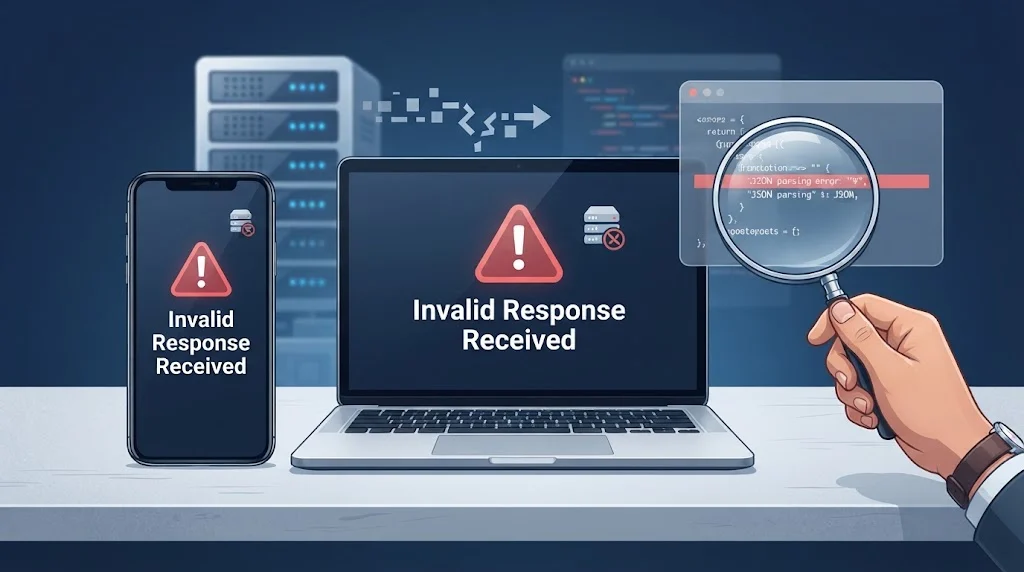
“Invalid response received” means your device sent a request and got back something it could not accept or understand. Common causes include server errors, network issues, expired sessions, and incompatible apps. Fix it by checking your connection, clearing cache, updating the app, or retrying later.
You tap a button, send a message, or open an app, and a message appears: “Invalid response received.” It is vague. It does not tell you what went wrong or whose fault it is. You are left guessing.
This error shows up in mobile apps, online banking, email clients, payment gateways, and API integrations. It means the client expected one thing, but the server sent another. The response was missing, malformed, or simply not what the system could accept.
For users, the fix is often simple: retry, update, or reconnect. For developers and support teams, the error is a signal to dig deeper into logs, response formats, and timeout settings. This article explains what causes the error, how to fix it on both sides, and what to say when you need to respond professionally.
What Does “Invalid Response Received” Actually Mean?
Every time your app talks to a server, it follows a pattern. The app sends a request. The server processes it and sends back a response. The app then reads that response and acts on it.
The message “Invalid response received” means something broke in that final step. The app received a response, but it could not use it. The data may be missing, incomplete, in the wrong format, or simply not what the app expected.
This is different from a network error. In a network error, no response arrives at all. Here, a response arrives, but it fails validation. The connection worked. The content did not.
The error can come from the client side, the server side, or a middle layer like a proxy or load balancer. Finding the source is the first step toward a fix.
Common Causes of Invalid Response Received
Several issues trigger this message. Most fall into one of these categories.
- Server errors (5xx): The server failed to process the request and returned an error page or empty body instead of valid data.
- Malformed data: The response was JSON, XML, or another format, but it had syntax errors or missing fields.
- Wrong content type: The server sent HTML when the app expected JSON, or vice versa.
- Expired or invalid session: The session token expired, and the server returned a login page instead of the expected response.
- Network interruption: The response was cut off mid-transfer, leaving incomplete data.
- Proxy or firewall interference: A middle layer modified or blocked the response.
- API version mismatch: The app expects an older or newer response schema.
- Server timeout: The request took too long, and the server returned a timeout page instead of data.
- Encoding problems: Special characters or byte order marks corrupted the response.
- Third-party service failure: An upstream service returned bad data that was passed along.
In practice, the cause is often a combination. For example, an expired token triggers a redirect. The app follows the redirect and receives an HTML login page. It tries to parse that as JSON and fails.
How to Diagnose the Problem
Before you can fix the error, you need to see what was actually received. Guessing wastes time and often leads to the wrong solution.
Capture the raw response. Add logging before the validation step. Print the status code, headers, and body. This shows exactly what the server sent.
Use developer tools. In a browser, open the Network tab. Find the failing request. Look at the Response tab and the Headers. The content type and status code often reveal the issue immediately.
Test outside the app. Use curl, Postman, or another HTTP client to send the same request. If it works there but fails in the app, the problem is in the app. If it fails everywhere, the problem is on the server.
Check the status code. A 200 means success. A 4xx or 5xx means an error. The status code tells you whether the request was accepted.
Review the timing. If the error happens after a long delay, it may be a timeout. If it happens instantly, it may be a validation failure.
Compare with a working request. Find a request that succeeds. Compare its headers, body, and timing with the failing one. The difference often points to the cause.
Once you see the raw response, the cause usually becomes clear.
How to Fix Invalid Response Received on the Client Side
If the problem is in how your app handles responses, these fixes help.
Add proper error handling. Wrap the response parsing in a try-catch block. If parsing fails, log the raw response and show a helpful message.
Check the content type before parsing. Verify that the response is the expected format. If it is HTML, treat it as an error instead of trying to parse it as JSON.
Handle empty responses. A 200 status with an empty body is a common cause. Check for empty bodies before parsing.
Validate the schema. Use a schema validation tool to confirm the response matches expectations. This catches missing fields and type mismatches early.
Add retry logic. If the error is transient, such as a network interruption, retry the request with exponential backoff.
Set timeouts. A request that hangs may eventually return partial data. Set a reasonable timeout and handle it.
Clear cache and cookies. Stale data can cause validation failures. Clearing cache often resolves user-facing issues.
Update the app. An outdated client may expect an old response format. Updates usually fix compatibility issues.
Here is a simple example of safe handling in JavaScript:
javascript
try {
  const contentType = response.headers.get("content-type");
  if (!contentType || !contentType.includes("application/json")) {
    throw new Error("Expected JSON but received: " + contentType);
  }
  const data = await response.json();
  return data;
} catch (error) {
  console.error("Invalid response. Raw body:", await response.text());
  throw new Error("Could not process server response");
}
This pattern catches the problem early and logs the raw body for debugging.
How to Fix Invalid Response Received on the Server Side
If the server is sending bad data, these fixes apply.
Return consistent content types. Always set Content-Type: application/json for JSON responses. Never let error pages return HTML for API routes.
Handle errors before they reach the client. Use middleware to catch exceptions and return structured JSON errors. Do not let stack traces or HTML error pages reach the client.
Validate outgoing data. Check that the data you serialize is valid. Watch for circular references, undefined values, and encoding issues.
Fix session handling. When a session expires, return a JSON error with a 401 status. Do not redirect to an HTML login page for API calls.
Version your API. When the response schema changes, version the endpoint. This prevents old clients from breaking.
Check proxy behavior. Sometimes the server is fine, but a proxy or CDN modifies the response. Test directly against the origin server.
Monitor error rates. If clients report invalid responses, track them. A spike usually indicates a server-side change.
Test with real clients. A response that works in Postman may fail in a mobile app due to different parsing rules.
Invalid Response Received: Replies for Developers and IT Teams
When this error appears in logs or tickets, clear communication speeds up the fix. Here are examples of replies for team chats, tickets, and incident updates.
Seeing invalid response errors on the /payments endpoint. Logging the raw response to check the format.
Use this when you first notice the error and are starting to investigate.
Meaning: The team knows the issue is being looked at and where to focus.
The server is returning an HTML login page instead of JSON. Fixing session expiry handling.
Use this when an expired session is the cause.
Meaning: The problem is understood and a specific fix is in progress.
Invalid response was caused by an empty body on a 200 status. Adding a check for empty responses.
Use this when the server returns success with no data.
Meaning: The client will handle empty responses gracefully.
The mobile app is failing to validate responses from the new API version. Checking schema compatibility.
Use this when a version mismatch is suspected.
Meaning: The investigation is focused on schema differences.
Error was transient. Retrying with exponential backoff resolved it. No code change needed.
Use this when the issue was network-related.
Meaning: The problem is resolved and the fix is in the retry logic.
Found a missing field in the JSON serializer. Deploying a patch.
Use this when the bug is in the server code.
Meaning: The root cause is identified and a fix is ready.
The CDN is caching an old error page. Need to purge the cache and update caching rules.
Use this when a CDN or proxy is serving stale content.
Meaning: The fix is in the infrastructure configuration.
Post-incident: invalid response errors resolved by validating response format before parsing. No data loss.
Use this for a final update after the issue is fixed.
Meaning: The incident is closed and the outcome is clear.
Invalid Response Received: Replies for Customer Support
Customers do not need technical details. They need a clear explanation and a next step.
We could not process the server’s response. Please try again in a few minutes.
Use this for a general invalid response error on a website or app.
Meaning: The user gets a simple instruction without jargon.
This error usually means the connection was interrupted. Please check your internet and retry.
Use this when a network issue is likely.
Meaning: The user understands the likely cause and has an action.
Your session may have expired. Please log out, log back in, and try again.
Use this when an expired session is the likely cause.
Meaning: The user knows how to re-authenticate.
The app received unexpected data from the server. Our team is aware and working on a fix.
Use this during an ongoing issue.
Meaning: The user knows the problem is acknowledged.
Try clearing your app cache and restarting the app.
Use this when stale data may be the cause.
Meaning: The user gets a specific troubleshooting step.
Please make sure you are using the latest version of the app.
Use this when an outdated client is the likely cause.
Meaning: The user knows to update.
If the error continues, please send us a screenshot. It helps us investigate.
Use this when you need more information.
Meaning: The user is invited to help without being blamed.
Thank you for your patience. The issue has been resolved. Please try your request again.
Use this for a final update.
Meaning: The user is informed that the issue is closed.
Common Mistakes When Handling This Error
Even experienced teams make mistakes with invalid response errors. Here are the most common ones.
Assuming it is always the server’s fault. Sometimes the client is too strict or expects the wrong format. Check both sides.
Ignoring the raw response. Without seeing the actual data, you are guessing. Always log it.
Not setting the correct content type. A server that returns HTML for an API route causes this error. Set the header properly.
Skipping error handling. A validation error without a try-catch block crashes the app. Always handle it.
Retrying without understanding. If the response is malformed, retrying will not help. Fix the data first.
Blaming the user. An invalid response is a technical issue. The user did nothing wrong.
Forgetting to test after a fix. Always verify that the change resolved the issue and did not create new ones.
Not versioning the API. Changing a schema without versioning breaks old clients. Plan for compatibility.
Best Practices for Preventing Invalid Response Errors
Prevention is better than debugging. These practices reduce the chance of this error appearing.
Use a shared schema. Define your response format in one place. Both client and server should reference it.
Validate on both sides. The server validates outgoing data. The client validates incoming data. Both catch problems early.
Return consistent errors. All API errors should return JSON, even 500 errors. Never return HTML for API routes.
Handle session expiry gracefully. Return a JSON 401 error instead of redirecting to a login page.
Test with multiple clients. A response that works in one client may fail in another. Test with different languages and libraries.
Monitor invalid response rates. Set up alerts for this error. A spike usually indicates a server-side change.
Document the response format. Clear documentation helps clients handle responses correctly.
Use graceful degradation. If validation fails, the app should show a helpful message instead of crashing.
FAQs
What does “invalid response received” mean in simple terms?
It means your app sent a request and got back something it could not accept. The response was missing, malformed, or in the wrong format. The app could not use it.
Is this error the client’s fault or the server’s fault?
It can be either. The server may send bad data. Or the client may expect the wrong format. Often, both sides contribute.
How do I fix this error on my phone?
Start by restarting the app and checking your internet connection. If that does not work, clear the app cache, log out and back in, and make sure the app is updated.
Why does this error appear when I try to log in?
It often means your session expired. The server returned a login page instead of the expected data. Log out completely, then log back in.
Can a slow internet connection cause this error?
Yes. If the connection drops mid-transfer, the response may be incomplete. The app receives partial data and cannot validate it.
What should I do if the error is intermittent?
Log the raw response when it happens. Look for patterns, such as a specific time or action. Intermittent errors often point to network issues or load balancer behavior.
How do I handle this error in JavaScript?
Check the content type before parsing. Wrap the parsing call in a try-catch block. Log the raw response text before parsing. If parsing fails, return a clear error.
How can I prevent this error in the future?
Use consistent content types, validate on both sides, version your API, and monitor error rates. Test with real clients, not just API tools.
Conclusion
“Invalid response received” is a clear signal that something in the communication chain broke. By inspecting the raw response, fixing the format, and adding proper error handling, you can resolve it quickly. Whether you are debugging code or helping a frustrated user, the right response turns confusion into action.
Read More Related Articles :
- 150+ Automatic Response Text Messages The Ultimate Guide to Auto Replies That Don’t Suck In 2026
- 150+ Automatic Response Outlook Messages: The Ultimate Guide to Auto Replies That Actually Work
- 130+ Best Replies For Every Email Response Time Tracking Situation In 2026

Robert Bennett is a passionate writer and blogger who turns everyday ideas into engaging stories and thoughtful insights.
Writing for RespondLabs.com, he brings a clear, relatable voice to topics that matter.