Quick Answer
Most B2B cold email campaigns see reply rates between 3% and 5% in 2026. Top performers reach 8% to 12% with tight targeting and genuine personalization. Below 2% usually signals a deliverability or targeting problem, not a copywriting one.
Cold email still works in B2B. It is just less forgiving than it used to be.
The average reply rate has dropped from around 8.5% in 2019 to roughly 3% to 3.4% today. Inboxes are fuller, spam filters are smarter, and buyers are quicker to delete anything that looks like a mass send.
But here is the part most benchmarks miss: the gap between average and elite performance has never been wider. Campaigns built on tight targeting, real personalization, and structured follow-ups are hitting 10% to 18% reply rates while high-volume blasts struggle below 2%.
This article breaks down the real numbers for 2026. It covers benchmarks by industry, what separates top performers from the rest, and how to diagnose and fix a low reply rate.
What Counts as a “Reply” in B2B Cold Email
Before you benchmark your campaign, you need to know which metric you are measuring. Not all replies are equal.
Total reply rate counts every response. That includes “not interested,” “remove me,” out-of-office messages, and genuine interest. This is the number most benchmark reports cite.
Positive reply rate counts only responses that express real interest. This is the number that maps to pipeline. Research from Sales.co analyzing over 2 million emails found that only 14.1% of replies were genuinely positive, yielding an interested reply rate of about 0.64%.
Meeting-booked rate counts replies that convert to a scheduled call or demo. This is the metric account executives actually care about.
If you are comparing your performance to a benchmark, make sure you are comparing the same metric. A 5% total reply rate with only 1% positive replies is very different from a 5% total reply rate with 3% positive replies.
2026 B2B Cold Email Response Rate Benchmarks
Here is where the numbers actually land this year.
| Performance Tier | Total Reply Rate | What It Signals |
|---|---|---|
| Bottom performers | Below 0.5% | Broken system: deliverability, data, or targeting |
| Industry average | 3% to 3.4% | Normal for broad B2B cold email |
| Good | 5%+ | Solid execution |
| Top quartile | 8% to 12% | Strong targeting and personalization |
| Elite | 10% to 18% | Tight ICP, buying signals, multi-touch sequences |
A 3% to 6% reply rate is a healthy benchmark for broad B2B cold email in 2026. Under 3% usually indicates a targeting or deliverability issue. Above 6% reflects strong execution. Above 8% is exceptional and usually tied to tight segmentation or prior familiarity with the sender.
The platform-wide average across all industries sits at 3.43%, according to 2026 benchmark data. That number has declined from 5.1% in 2024, driven by inbox saturation and tighter spam enforcement.
But averages hide massive variation. A campaign that flops at 0.4% in one industry can hit 6% in another with the same copy.
B2B Cold Email Reply Rates by Industry
Industry context matters more than overall averages. A 3% reply rate might signal excellence in enterprise SaaS but mediocrity in manufacturing.
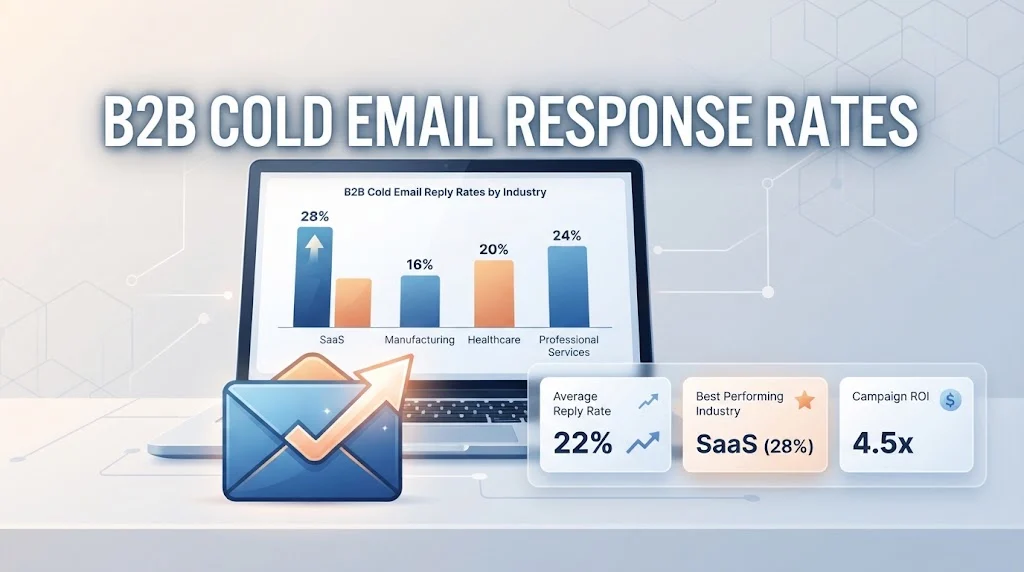
Here are the realistic 2026 benchmarks by vertical:
SaaS and technology: 1.0% to 3.5% total reply rate. The most saturated inbox category. SaaS buyers receive dozens of pitches weekly, and inbox fatigue drives down engagement. Positive reply rates hover around 1.8%.
Marketing agencies: 0.5% to 2.0%. Agencies receive the most cold email per capita, and reply rates suffer accordingly.
Professional services (law, accounting, consulting): 2.0% to 4.5%. Less crowded, with higher individual responsiveness. Revenue and time savings metrics resonate more than technical features.
Manufacturing and industrial: 3.0% to 6.5%. Often the highest reply rates in B2B because inbox volume is lower and spam filtering is less aggressive.
Healthcare and life sciences: 1.5% to 4.0%. Heavy spam filtering, strict IT policies, and long decision cycles all suppress performance. Cold calling and LinkedIn often outperform email in this vertical.
Financial services: 0.8% to 2.5%. Heavily gated by compliance and inbox security tools. Trigger events like regulatory changes or funding rounds work best as hooks.
Real estate: 3.0% to 7.0%. Strong responsiveness on relevant offers.
Logistics and supply chain: 6.8% average reply rate. One of the highest-performing verticals, with less inbox saturation and more responsive decision-makers.
The 15x spread between the lowest and highest industries is not about copy quality. It is about inbox saturation. A SaaS founder gets 15 to 40 cold pitches per day. A mid-market services owner gets 5 to 15. Your ceiling is set before you write a single line.
Reply Rates by Decision-Maker Seniority
Title matters as much as industry. The person you are emailing changes everything.
CEO or founder (sub-50 person companies): 4% to 10% reply rate. Surprisingly high responsiveness on relevant offers. These decision-makers are close to the problem and can act quickly.
CEO or founder (50+ person companies): 0.5% to 2%. Gated by executive assistants and aggressive inbox filters.
VP Sales or VP Marketing: 1.5% to 4%. Busy but reachable with a relevant hook.
Director-level: 2% to 5%. The sweet spot for most B2B SaaS targeting. Senior enough to make decisions, junior enough to still read email.
Manager-level: 3% to 6%. Higher responsiveness but lower deal influence.
Individual contributor or specialist: 3% to 7%. Responds often, but may not have budget authority.
C-level executives respond at 6.4% when the outreach demonstrates genuine account knowledge, well above the 3% to 5% average. The key is relevance, not seniority.
What Separates Top Performers from the Rest
Across thousands of B2B campaigns, top-quartile performance shares five characteristics.
Specific personalization tied to a verifiable trigger. Not “I loved your LinkedIn profile.” Instead: funding round, job change, technology stack, website visit, or earnings commentary. Advanced personalization lifts reply rates to 18% compared to 9% for basic templates.
Short, single-question first emails. Under 90 words with one clear question. Emails with 6 to 8 sentences and under 200 words see 6.9% reply rates, higher than average.
Clean sender infrastructure. Warmed mailboxes, SPF, DKIM, and DMARC aligned, sending under 50 emails per day per mailbox. Deliverability is now the single biggest variable in campaign performance, ahead of subject lines or copy quality.
Genuine targeting filters. ICP filters tight enough that most recipients could plausibly buy. Smaller lists win consistently. Campaigns under 50 recipients average 5.8% reply rate versus 2.1% for lists of 1,000 or more.
Multi-step sequences with value. Four to six touches over three weeks, each adding context rather than nagging. 42% of all replies come from follow-ups, yet 48% of reps never send one. Campaigns with 3 to 5 steps hit 8.3% reply rates.
How to Calculate Your Own Benchmark
Before you can improve your reply rate, you need to know your baseline. Here is how to calculate it accurately.
Step 1: Define your metric. Are you measuring total replies, positive replies, or meetings booked? Pick one and stick with it.
Step 2: Count delivered emails, not sent emails. Subtract bounces from your total sends. A 5% bounce rate inflates your reply rate if you count sent emails instead of delivered ones.
Step 3: Segment by industry and persona. A single blended number hides where you are winning and losing. Break it down by vertical, company size, and job title.
Step 4: Track over time. A single campaign is a data point. Four weeks of data shows a trend. Compare month over month.
Step 5: Set realistic targets. Use the industry benchmarks above as your guide. If you are in SaaS targeting enterprise accounts, a 3% reply rate is good. If you are in manufacturing targeting mid-market, 5% is achievable.
How to Improve B2B Cold Email Response Rates
If your reply rate is below 3%, something in your system is broken. It is rarely just the copy.
Fix deliverability first. If your emails are landing in spam, no amount of copywriting will help. Check your SPF, DKIM, and DMARC records. Warm up new domains. Keep bounce rates under 2%. Use tools like mail-tester to verify inbox placement.
Tighten your ICP. A smaller, more targeted list consistently outperforms a large, vague one. If you cannot articulate why a specific person needs your product right now, do not email them.
Personalize with real research. Reference a specific business event: a funding round, a new hire, a product launch, a regulatory change. This takes five minutes per account but triples reply rates compared to template-based outreach.
Write shorter emails. Under 90 words. One question. No links in the first email. The goal is not to sell. The goal is to start a conversation.
Fix your subject lines. Keep them under 50 characters. Use questions when appropriate. Avoid spam trigger words like “free,” “guarantee,” or “act now”.
Build a follow-up sequence. Three to five emails, spaced three to five days apart. Each follow-up must add new value, not just bump the thread. Never send “just checking in” or “bumping this”.
Test systematically. A/B test one variable at a time: subject line, opening line, CTA, or send time. Analyzing your replies, both positive and negative, improves results more than staring at reply rates.
Send at the right time. Tuesday to Thursday, 9 to 11 a.m. in the recipient’s local time zone works best. Avoid early mornings before 8 a.m. and late afternoons.
Remove links from cold emails. Links in the first email, including signature links, can trigger spam filters and reduce deliverability.
Common Mistakes That Kill Reply Rates
Even experienced teams make these mistakes. Fixing them can double or triple your response rate.
Chasing open rates instead of replies. Apple Mail Privacy Protection inflates open rates by pre-loading tracking pixels. Treat open rate as a directional signal, not a precise KPI. Focus optimization on replies.
Sending too many follow-ups. Adding a third email can drop reply rates by 20%. Short, thoughtful sequences outperform long, persistent ones.
Using generic personalization. “I loved your recent LinkedIn post” is not personalization. It is a template. Reference something verifiable and specific to the company’s business.
Ignoring negative replies. Negative replies are data. They tell you what is wrong with your targeting, your offer, or your messaging. Analyze them.
Blaming the copy when deliverability is the problem. A reply rate below 1% is almost always a deliverability or data quality issue, not a writing issue.
Sending from a single mailbox at high volume. Sending more than 50 emails per day per mailbox damages your sender reputation. Use multiple warmed mailboxes.
Not segmenting by industry. The same email that works in manufacturing will fail in SaaS. Different industries have different inbox saturation levels and different buying triggers.
Forgetting to ask for a low-friction next step. “Want a quick chat?” converts better than “Can we schedule a 30-minute demo?” The lower the commitment, the higher the response rate.
Copy-Ready Cold Email Templates
These templates are starting points. Customize every line. Do not send them as-is.
Template: Trigger-Based Opening
text
Subject: [Specific trigger event]

Hi [Name],

Saw that [Company] just [trigger event: raised Series B, launched X product, hired VP of Y]. Usually when that happens, [specific challenge] becomes a priority.

We helped [similar company] [specific outcome] in [timeframe].

Worth a quick conversation?

[Your name]
Template: Referral or Introduction
text
Subject: [Mutual connection] suggested I reach out

Hi [Name],

[Mutual connection] mentioned you are working on [specific initiative]. We worked with them on something similar and [specific result].

Would it make sense to compare notes?

[Your name]
Template: Short and Direct
text
Subject: [Specific observation about their business]

Hi [Name],

Noticed [specific observation]. Most [role] we talk to are dealing with [related challenge].

We solve that by [one-sentence value prop].

Open to a 15-minute call?

[Your name]
Template: Follow-Up Adding Value
text
Subject: Re: [Original subject]

Hi [Name],

Following up with something useful. [Link to a relevant case study, article, or data point]. It shows how [similar company] handled [challenge].

No pitch. Just thought it might help.

[Your name]
Frequently Asked Questions
What is a good B2B cold email reply rate in 2026?
A 3% to 6% total reply rate is healthy for broad B2B cold email. Above 6% is strong. Above 8% is exceptional and usually tied to tight ICP segmentation or buying signals.
Why is my cold email reply rate below 1%?
A reply rate below 1% almost always signals a deliverability problem, not a copywriting problem. Check your SPF, DKIM, and DMARC records. Verify inbox placement. Audit your list for invalid or spam-trap addresses.
How many follow-ups should I send?
Three to five emails, spaced three to five days apart. Each follow-up must add new value. Do not send “just checking in” messages. 42% of replies come from follow-ups, but only if the follow-ups are useful.
Does personalization actually improve reply rates?
Yes. Advanced personalization, referencing a specific business trigger rather than just a first name, lifts reply rates to 18% compared to 9% for basic templates. The key is relevance, not just using a merge tag.
What is the best time to send B2B cold emails?
Tuesday to Thursday, between 9 a.m. and 11 a.m. in the recipient’s local time zone. Avoid early mornings before 8 a.m. and Friday afternoons.
Should I include links in cold emails?
No. Links in the first email, including signature links, can trigger spam filters and reduce deliverability. Remove all links from cold outreach.
How do I benchmark against my industry?
Use the industry-specific numbers in this article. SaaS targets 1% to 3.5%. Manufacturing targets 3% to 6.5%. Healthcare targets 1.5% to 4%. Compare like-for-like. Do not benchmark a healthcare campaign against a manufacturing average.
What is the difference between total reply rate and positive reply rate?
Total reply rate counts every response, including “not interested” and out-of-office messages. Positive reply rate counts only responses that express genuine interest. Only 15% to 35% of replies are positive in well-targeted campaigns.
Conclusion
B2B cold email response rates have settled into a new normal. Three to five percent is average. Eight to twelve percent is achievable with discipline. The difference is not better copy. It is tighter targeting, cleaner data, smarter sequences, and a focus on relevance over volume. Measure the right metric, benchmark against your industry, and fix the system before you rewrite the email.
Read More Related Articles :
- 150+ Automatic Response Text Messages The Ultimate Guide to Auto Replies That Don’t Suck In 2026
- 150+ Automatic Response Outlook Messages: The Ultimate Guide to Auto Replies That Actually Work
- 130+ Best Replies For Every Email Response Time Tracking Situation In 2026

James Wilson is a passionate blogger and writer at RespondLabs.com, sharing fresh perspectives on technology, business and everyday digital trends. His writing combines clear insights with an engaging, reader-friendly style.