Quick Answer
An unconditioned response is a natural, unlearned reaction to a stimulus. A conditioned response is a learned reaction built through association. The first happens automatically. The second develops through repeated pairing.
Two terms sit at the heart of classical conditioning: unconditioned response and conditioned response. They sound similar. They often appear in the same sentence. But they describe two very different things.
One is natural. You are born with it. The other is learned. It develops through experience.
Confusing the two is one of the most common mistakes in psychology courses. It also leads to misreading research studies and misunderstanding how learning works.
This article breaks down the unconditioned response vs conditioned response distinction in plain language. It covers definitions, examples, a side-by-side comparison, and how to tell them apart in any scenario. By the end, you will be able to identify each one with confidence.
What Is an Unconditioned Response?
An unconditioned response (UR) is an automatic, unlearned reaction to a stimulus. It happens naturally without any prior conditioning. The response is involuntary and occurs without conscious thought.
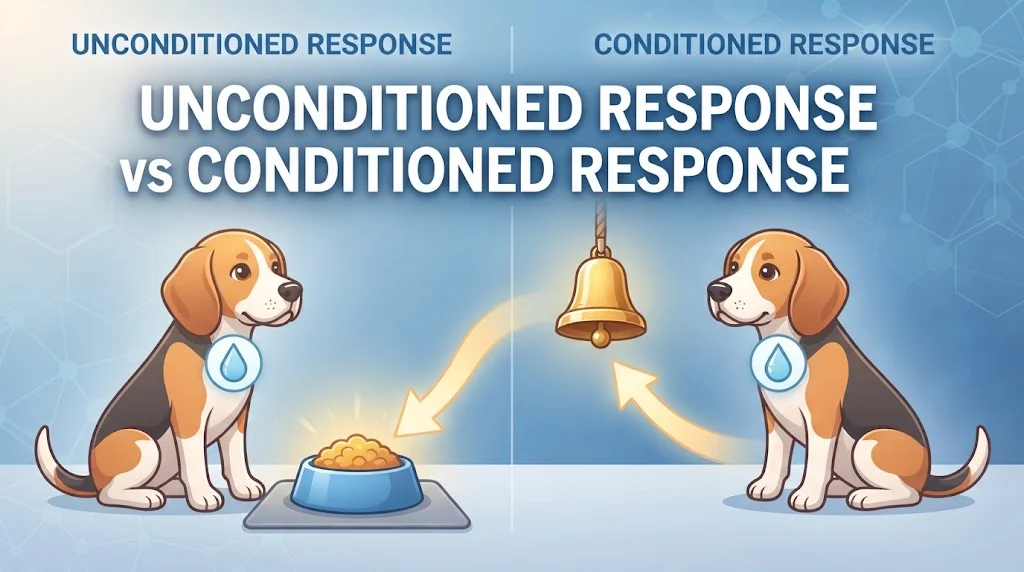
The term comes from classical conditioning, first described by Ivan Pavlov. In his experiments, dogs salivated when they saw or smelled food. This salivation was not learned. It was a natural biological response.
Key features of an unconditioned response:
- It is innate. You are born with it.
- It requires no learning or experience.
- It is triggered by an unconditioned stimulus (US).
- It is involuntary and automatic.
- It serves a biological or survival function.
Examples include flinching at a loud noise, blinking when air hits your eye, and pulling your hand away from a hot surface. These reactions happen without any prior training.
The unconditioned response is the baseline. It is what the organism already does before conditioning begins.
What Is a Conditioned Response?
A conditioned response (CR) is a learned reaction to a stimulus that was previously neutral. It develops through repeated pairing of a neutral stimulus with an unconditioned stimulus.
In Pavlov’s experiments, the dogs eventually salivated at the sound of a bell alone. The bell was originally a neutral stimulus. After being paired with food multiple times, it became a conditioned stimulus (CS). The salivation in response to the bell was the conditioned response.
Key features of a conditioned response:
- It is learned. It develops through experience.
- It requires repeated pairing of two stimuli.
- It is triggered by a conditioned stimulus (CS).
- It can fade over time if the CS is presented without the US (extinction).
- It can reappear after a pause (spontaneous recovery).
Examples include feeling anxious when you hear a dentist’s drill, salivating when you hear a dinner bell, or feeling hungry when you see a fast-food logo. These reactions are not innate. They are acquired.
The conditioned response is built on top of the unconditioned response. Without the UR, conditioning cannot occur.
The Core Difference: Learning vs Biology
The fundamental difference between an unconditioned response and a conditioned response is learning. One is biological. The other is acquired.
An unconditioned response is part of your natural wiring. You do not need to be taught to flinch at a loud noise. Your body does it automatically. It is a survival mechanism.
A conditioned response is created through experience. You learn to associate a neutral stimulus with something that naturally triggers a response. Over time, the neutral stimulus alone can trigger the response.
Think of it this way. The unconditioned response is the raw material. The conditioned response is the finished product. Conditioning is the process that transforms one into the other.
This distinction matters because it explains how organisms adapt to their environments. They start with innate reactions and build learned associations on top of them.
Side-by-Side Comparison Table
A table makes the differences clear at a glance.
| Feature | Unconditioned Response | Conditioned Response |
|---|---|---|
| Learning required | No | Yes |
| When it appears | Before conditioning | After conditioning |
| Trigger | Unconditioned stimulus (US) | Conditioned stimulus (CS) |
| Nature | Innate, automatic | Learned, acquired |
| Biological basis | Yes, hardwired | No, developed |
| Can be extinguished | No | Yes |
| Example | Salivating at food | Salivating at a bell |
| Universality | Similar across species | Varies by individual |
This table captures the essential differences. Use it as a quick reference when studying or analyzing scenarios.
How They Work Together in Classical Conditioning
The unconditioned response and the conditioned response are not opposites. They are partners in the same process. Understanding how they interact is key to mastering classical conditioning.
Here is the sequence:
Step 1: Before conditioning. The unconditioned stimulus (US) triggers the unconditioned response (UR). Food causes salivation. A loud noise causes flinching.
Step 2: During conditioning. A neutral stimulus (NS) is presented just before the unconditioned stimulus. The bell rings, then food appears. The dog salivates at the food.
Step 3: After conditioning. The neutral stimulus becomes a conditioned stimulus (CS). It now triggers a response on its own. The bell rings, and the dog salivates even without food. This is the conditioned response (CR).
The unconditioned response is the foundation. The conditioned response is the learned extension. Without the UR, there would be nothing to condition.
This process explains how phobias develop, how advertising works, and how animals learn to respond to cues in their environment.
Examples That Show the Difference
Examples make the distinction concrete. Here are scenarios that highlight both types of responses.
Pavlov’s Dogs
- Unconditioned stimulus: Food
- Unconditioned response: Salivation at food
- Neutral stimulus: Bell
- Conditioned stimulus: Bell after pairing
- Conditioned response: Salivation at bell
Little Albert
- Unconditioned stimulus: Loud noise
- Unconditioned response: Fear and crying
- Neutral stimulus: White rat
- Conditioned stimulus: White rat after pairing
- Conditioned response: Fear at the sight of the rat
Example 3: Dentist’s Drill
- Unconditioned stimulus: Pain from dental work
- Unconditioned response: Discomfort and fear
- Neutral stimulus: Sound of the drill
- Conditioned stimulus: Sound of the drill after pairing
- Conditioned response: Anxiety at the sound alone
Example 4: Food Aversion
- Unconditioned stimulus: A food that causes nausea
- Unconditioned response: Nausea and vomiting
- Neutral stimulus: The smell or taste of that food
- Conditioned stimulus: The smell or taste after pairing
- Conditioned response: Nausea at the smell alone
In each case, the unconditioned response is natural. The conditioned response is learned through association.
Real-World Applications of This Distinction
Understanding the difference between unconditioned and conditioned responses has practical value. It applies in therapy, marketing, education, and everyday life.
Therapy. Therapists use classical conditioning principles to treat phobias. They help patients unlearn conditioned fear responses by pairing the feared stimulus with relaxation. The relaxation response is unconditioned. The fear response is conditioned.
Advertising. Advertisers pair products with images that trigger positive unconditioned responses. A smiling baby or a beautiful landscape naturally evokes good feelings. When paired with a product, those feelings become a conditioned response to the brand.
Education. Teachers use conditioning to create positive associations with learning. A friendly classroom environment triggers natural feelings of safety. Over time, students may develop a conditioned response of enthusiasm for school.
Health and medicine. Doctors use unconditioned responses to assess neurological function. Reflex tests check whether the nervous system is working properly. Conditioned responses are used in biofeedback to help patients control physiological functions.
Animal training. Trainers use unconditioned responses as the starting point for teaching new behaviors. Food naturally motivates an animal. Trainers pair it with cues to create conditioned responses.
Addiction and recovery. Cravings can be conditioned responses. A person may associate certain places or people with substance use. The craving is learned. Understanding this helps in recovery.
In each case, knowing which response is which guides effective action.
How to Identify Each in a Scenario
On exams or in research, you will be asked to identify unconditioned and conditioned responses. Here is a step-by-step method.
Step 1: Identify the natural reaction. What does the organism do automatically? This is likely the unconditioned response.
Step 2: Identify the stimulus that triggers it. What naturally causes that reaction? This is the unconditioned stimulus.
Step 3: Identify the neutral stimulus. What was present before conditioning but did not trigger the response? This is the neutral stimulus.
Step 4: Check for pairing. Was the neutral stimulus paired with the unconditioned stimulus? If yes, it may become a conditioned stimulus.
Step 5: Identify the learned reaction. After conditioning, what does the organism do in response to the conditioned stimulus? This is the conditioned response.
Step 6: Confirm the learning. Did the response develop through experience? If yes, it is conditioned. If it was present from birth, it is unconditioned.
Practice this method with different scenarios. The more you practice, the faster you will recognize the patterns.
Common Mistakes When Comparing These Terms
Students and learners often make mistakes when working with these concepts. Here are the most common ones.
Confusing the stimulus with the response. The stimulus is what triggers the reaction. The response is the reaction itself. Mixing them up leads to wrong answers.
Assuming all responses are conditioned. Some responses are natural and unlearned. Do not label them as conditioned unless learning is involved.
Forgetting the role of learning. The key difference is whether learning occurred. If no learning occurred, the response is unconditioned.
Mixing up the UR and CR in examples. In Pavlov’s experiment, salivation at food is the UR. Salivation at the bell is the CR. Keep them straight.
Ignoring the sequence. The UR comes before conditioning. The CR comes after. The order matters.
Using imprecise terminology. Use the exact terms. “Unconditioned” not “unconditional.” Precision matters.
Overlooking extinction. Conditioned responses can fade if the CS is presented without the US. Unconditioned responses do not extinguish.
Failing to apply the concept. Memorizing definitions is not enough. You need to apply them to new scenarios.
Study Tips for Mastering This Concept
Mastering the unconditioned response vs conditioned response distinction takes practice. Here are some tips.
Create a comparison chart. Write down the key differences side by side. Review it regularly.
Use real-life examples. Think of times when you experienced each type of response. This makes the concepts concrete.
Practice labeling. Take scenarios from your textbook or practice tests. Label the US, UR, CS, and CR.
Draw the conditioning process. Visual representations help you see the sequence.
Teach someone else. Explaining the concepts to a friend reinforces your understanding.
Take practice quizzes. Many psychology resources offer quizzes on classical conditioning. Use them to test your knowledge.
Review Pavlov’s experiment. The original study is the best example. Know it inside and out.
Connect to other concepts. Link these terms to related topics like operant conditioning and observational learning.
FAQs
What is the main difference between an unconditioned response and a conditioned response?
An unconditioned response is natural and unlearned. A conditioned response is learned through association. The UR happens before conditioning. The CR happens after.
Can a conditioned response become an unconditioned response?
No. They are fundamentally different. A conditioned response is learned. An unconditioned response is innate. However, a conditioned response can be built on top of an unconditioned response.
How do I tell them apart in an exam question?
Look for the reaction that happens naturally and automatically. Ask yourself: did the organism learn this response, or is it innate? If it is innate, it is the unconditioned response. If it was learned, it is the conditioned response.
Is salivation an unconditioned response or a conditioned response?
It can be both. Salivation at the sight of food is an unconditioned response. Salivation at the sound of a bell, after conditioning, is a conditioned response. The context determines which one it is.
Why does the conditioned response fade over time?
This is called extinction. If the conditioned stimulus is presented repeatedly without the unconditioned stimulus, the conditioned response weakens and eventually disappears.
Can unconditioned responses be changed?
Unconditioned responses are innate, so they cannot be learned or unlearned. However, their intensity can be influenced by factors like fatigue, stress, and health.
How does spontaneous recovery relate to conditioned responses?
Spontaneous recovery is the reappearance of a conditioned response after a pause. It shows that the learned association is not completely forgotten, even after extinction.
What are some real-world examples of conditioned responses?
Feeling anxious when you hear a dentist’s drill, craving food when you see a fast-food logo, and feeling nervous before a presentation are all conditioned responses. They develop through association.
Conclusion
The unconditioned response vs conditioned response distinction is simple once you see it clearly. One is natural. The other is learned. One comes first. The other builds on it. Mastering this difference unlocks the rest of classical conditioning.
Read More Related Articles :
- 150+ Automatic Response Text Messages The Ultimate Guide to Auto Replies That Don’t Suck In 2026
- 150+ Automatic Response Outlook Messages: The Ultimate Guide to Auto Replies That Actually Work
- 130+ Best Replies For Every Email Response Time Tracking Situation In 2026

Sarah Mitchell is a blogger and writer at RespondLabs.com, turning everyday ideas into clear, engaging stories.
She enjoys exploring fresh perspectives and creating content that keeps readers curious and informed.