Quick Answer
An unconditioned response in psychology is an automatic, unlearned reaction to a stimulus. It occurs naturally without any prior conditioning. Common examples include salivating at the smell of food, flinching at a loud noise, and blinking when air hits the eye.
Psychology has a lot of terms that sound complicated but describe simple things. The unconditioned response is one of them. It is a reaction your body produces without being taught.
You do not learn to pull your hand away from a hot stove. You do not learn to blink when something moves toward your eye. These reactions are built in. They happen automatically.
The unconditioned response definition in psychology matters because it anchors classical conditioning. Without a natural reaction, there would be nothing to condition. Pavlov’s dogs could not have learned to salivate at a bell if they did not already salivate at food.
This article explains the concept in clear language. It covers the definition, the research behind it, examples across different domains, and how it differs from related terms. Whether you are a student, a therapist in training, or simply curious about how learning works, this guide gives you a solid understanding.
What Is an Unconditioned Response? The Core Definition
An unconditioned response (UR) is an unlearned, automatic reaction to a stimulus. It occurs naturally and does not require any prior experience, training, or conditioning. The response is involuntary and happens without conscious effort.
The term comes from classical conditioning, a learning theory first developed by Ivan Pavlov. In his experiments, Pavlov noticed that dogs salivated when they saw food. This salivation was not learned. It was a natural biological response.
The word “unconditioned” means the response is not dependent on any learned association. It exists before conditioning begins. It is part of the organism’s innate biology.
In psychology, the unconditioned response is always paired with an unconditioned stimulus (US). The stimulus triggers the response. Together, they form the baseline that makes learning possible.
The Origins: Pavlov and Classical Conditioning
Ivan Pavlov was a Russian physiologist studying digestion in the late 1800s. He noticed something odd. Dogs in his lab salivated not only when they received food but also when they heard the footsteps of the person bringing it.
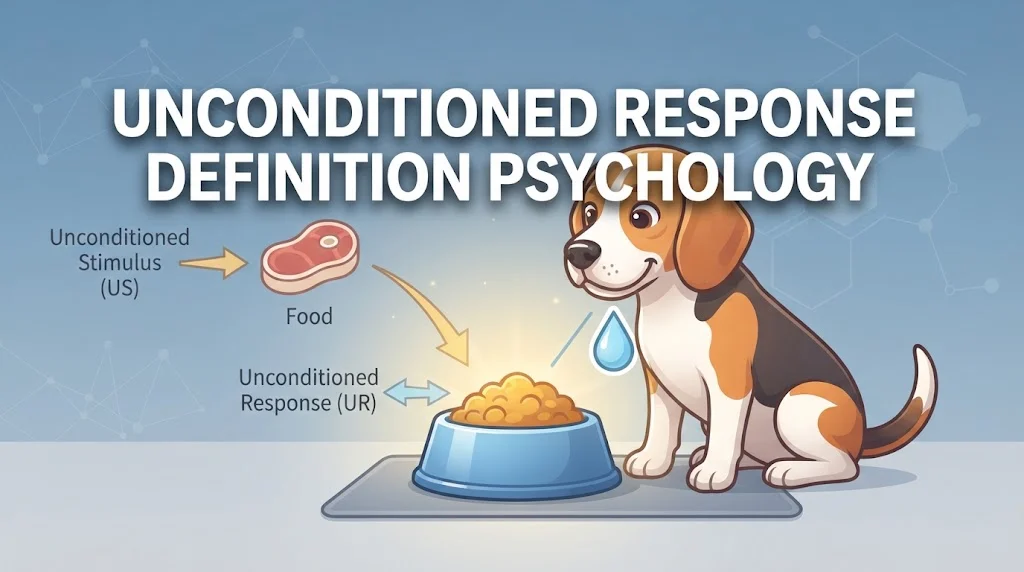
This observation led to a series of experiments that became the foundation of classical conditioning. Pavlov presented dogs with food and measured their salivation. The food was the unconditioned stimulus. The salivation was the unconditioned response.
Then Pavlov introduced a neutral stimulus, such as a bell or a light. At first, the dogs did not salivate at the bell. But after pairing the bell with food multiple times, the dogs began to salivate at the sound of the bell alone. The bell had become a conditioned stimulus, and the salivation had become a conditioned response.
The unconditioned response was the starting point. It was what the dogs already did before any learning occurred. Without it, the conditioning would not have worked.
Pavlov’s work earned him a Nobel Prize in 1904. It also laid the groundwork for behaviorism, a major school of thought in psychology.
Unconditioned Response vs Unconditioned Stimulus
One of the most common points of confusion is the difference between the unconditioned response and the unconditioned stimulus. They are two distinct parts of the same process.
The unconditioned stimulus is what triggers the reaction. The unconditioned response is the reaction itself.
In Pavlov’s experiment, food is the unconditioned stimulus. Salivation is the unconditioned response.
Think of it as cause and effect. The stimulus is the cause. The response is the effect.
On a psychology exam, a question might describe a scenario and ask you to identify the US and the UR. Read carefully. The stimulus is the event or object. The response is what the organism does.
For example: “A person smells smoke and immediately feels anxious.” The smell of smoke is the US. The anxiety is the UR.
Understanding this distinction is essential for correctly analyzing classical conditioning scenarios.
Unconditioned Response vs Conditioned Response
Another key distinction is between the unconditioned response and the conditioned response. The difference comes down to learning.
An unconditioned response is natural and unlearned. It happens without any prior experience. You do not learn to flinch at a loud noise. You just do.
A conditioned response is learned. It happens because of an association between two stimuli. You learn to feel anxious when you hear a dentist’s drill because you associate it with pain.
Here is a simple comparison:
| Feature | Unconditioned Response | Conditioned Response |
|---|---|---|
| Learning required | No | Yes |
| When it appears | Before conditioning | After conditioning |
| Trigger | Unconditioned stimulus | Conditioned stimulus |
| Nature | Automatic, innate | Learned, acquired |
| Example | Salivating at food | Salivating at a bell |
The unconditioned response comes first. The conditioned response is built on top of it. This sequence is what makes classical conditioning possible.
On exams, questions often ask you to identify which is which. Look for the word “naturally” or “automatically.” If the response happens without prior learning, it is unconditioned.
Key Examples of Unconditioned Responses
Examples help make the concept concrete. Here are some of the most common unconditioned responses studied in psychology.
Salivation in response to food. This is the classic example from Pavlov’s work. The sight or smell of food triggers salivation automatically.
Flinching at a loud noise. A sudden loud sound causes a person to startle or flinch. This is an automatic defensive reaction.
Blinking when air is puffed into the eye. This is used in eye blink conditioning studies. The puff of air is the US, and the blink is the UR.
Pupil dilation in response to darkness. When light levels drop, the pupils widen to let in more light. This happens automatically.
Withdrawing your hand from a hot surface. Before you consciously feel pain, your hand pulls back. This is a spinal reflex, a type of unconditioned response.
Feeling fear at a sudden loud bang. The startle response and the release of adrenaline are automatic. They do not require conditioning.
Nausea in response to a bad smell. Certain odors trigger nausea without any prior learning. This is a natural protective reaction.
Tears when something irritates the eye. The eye produces tears to flush out irritants. This is an automatic response.
Increased heart rate during exercise. The heart beats faster to deliver more oxygen to muscles. This is an unconditioned physiological response.
Knee-jerk reflex. Tapping the patellar tendon causes the lower leg to kick forward. This is a classic neurological reflex and an unconditioned response.
Each example shows the same pattern. A natural stimulus triggers a natural response. No learning is involved.
Types of Unconditioned Responses in Psychology
Unconditioned responses fall into several categories based on their function and biological basis.
Reflexes. These are simple, involuntary movements triggered by a specific stimulus. Examples include the knee-jerk reflex and the withdrawal reflex.
Emotional responses. These involve the autonomic nervous system. Fear, surprise, and relief are examples. They prepare the body to respond to threats or opportunities.
Physiological responses. These involve internal bodily functions. Salivation, heart rate changes, and pupil dilation are examples.
Defensive responses. These protect the organism from harm. Flinching, blinking, and recoiling from pain are examples.
Appetitive responses. These relate to seeking or consuming resources. Salivation in response to food and increased arousal in response to a potential mate are examples.
Understanding these categories helps you see the range of unconditioned responses and how they support survival.
How Researchers Measure Unconditioned Responses
Psychologists study unconditioned responses using precise measurement tools. These methods help them establish a baseline and track changes during conditioning.
Salivary response measurement. In Pavlov’s work, salivation was measured by collecting saliva or observing the amount produced. Modern studies may use more precise tools.
Startle response measurement. The startle response is measured using electromyography (EMG), which records muscle activity. This is common in fear conditioning studies.
Eye blink measurement. In eye blink conditioning, a sensor measures how quickly and strongly the eye blinks in response to a puff of air.
Heart rate measurement. Some unconditioned responses involve changes in heart rate. These are measured using electrocardiography (ECG).
Skin conductance response. Also called the galvanic skin response (GSR), this measures sweat gland activity. It is used to study emotional responses.
Pupillometry. This measures changes in pupil size. It is used to study attention, arousal, and cognitive load.
Researchers use these measurements to establish a baseline. The baseline is the unconditioned response before conditioning. Then they track how the response changes as conditioning occurs.
Unconditioned Responses in Everyday Life
The concept is not just for the classroom. It shows up in daily life in many ways.
Advertising. Advertisers pair products with images that trigger positive unconditioned responses. A smiling baby or a beautiful landscape naturally evokes good feelings. When paired with a product, those feelings transfer.
Food preferences. You may feel hungry when you smell freshly baked bread. This is an unconditioned response to the aroma. Over time, you may associate certain places or times with that smell, creating a conditioned response.
Fear and phobias. A natural fear of heights or loud noises is an unconditioned response. Phobias develop when a neutral stimulus becomes associated with that fear.
Social interactions. You may smile when you see a friendly face. This is an automatic response. It helps build social bonds.
Exercise and stress. Your heart rate increases during exercise or stressful situations. This is a natural physiological response that prepares your body for action.
Parenting. Babies cry when they are hungry or uncomfortable. This is an unconditioned response. Parents learn to recognize different cries and respond accordingly.
In each case, the unconditioned response is the natural starting point. Learning builds on it.
Clinical and Therapeutic Applications
The concept of the unconditioned response has practical applications in therapy and medicine.
Systematic desensitization. This therapy helps people overcome phobias. The therapist teaches relaxation techniques, which trigger an unconditioned relaxation response. Then the patient is gradually exposed to the feared stimulus while maintaining relaxation. Over time, the fear response is replaced by relaxation.
Aversion therapy. This therapy pairs an unwanted behavior with an unpleasant stimulus. For example, a person trying to quit smoking might be given a substance that makes cigarettes taste bad. The unpleasant taste is an unconditioned response. Over time, the person associates smoking with the bad taste and avoids it.
Exposure therapy. This therapy helps people confront feared situations in a safe environment. The natural fear response is an unconditioned response. Through repeated exposure, the fear diminishes.
Biofeedback. This technique helps people control physiological responses like heart rate and muscle tension. By becoming aware of these unconditioned responses, people can learn to regulate them.
Neurological assessment. Doctors use reflex tests to check nervous system function. The knee-jerk reflex and other unconditioned responses can reveal neurological damage or disease.
These applications show how understanding unconditioned responses can lead to effective treatments.
Common Misconceptions About Unconditioned Responses
Several misconceptions surround the unconditioned response. Clearing them up helps you avoid errors.
Misconception 1: All responses are learned. Some responses are innate. Unconditioned responses are natural and do not require learning.
Misconception 2: Unconditioned responses are always simple reflexes. While reflexes are one type, unconditioned responses also include emotional and physiological reactions.
Misconception 3: Unconditioned responses cannot change. While they are innate, their intensity can be influenced by factors like fatigue, stress, and health. However, the basic response remains.
Misconception 4: Unconditioned responses are the same for everyone. While many are universal, some vary based on individual biology and experience. For example, food preferences can affect salivation.
Misconception 5: Unconditioned responses are not relevant to learning. They are the foundation of classical conditioning. Without them, learning through association would not be possible.
Misconception 6: The term “unconditioned” means the response is abnormal. It simply means the response is not conditioned or learned. It is a neutral technical term.
How to Identify an Unconditioned Response
Identifying an unconditioned response in a scenario is a skill. Here are steps to help you do it accurately.
Look for the natural reaction. Ask yourself: does this response happen automatically, or did the organism learn it? If it is automatic, it is likely unconditioned.
Identify the stimulus. What triggered the response? If the stimulus naturally causes the reaction, it is an unconditioned stimulus.
Check for prior learning. Was there any conditioning involved? If not, the response is unconditioned.
Consider the biology. Unconditioned responses are rooted in biology. They serve a survival or regulatory function.
Compare with conditioned responses. If the same response occurs after conditioning to a new stimulus, the original is unconditioned, and the new one is conditioned.
Practice with examples. The more scenarios you analyze, the easier it becomes to identify the components of classical conditioning.
Common Mistakes When Studying This Concept
Students and learners often make mistakes when working with unconditioned responses. Here are the ones to watch for.
Confusing the stimulus with the response. The stimulus is what triggers the reaction. The response is the reaction itself. Mixing them up leads to wrong answers.
Assuming all responses are conditioned. Some responses are natural and unlearned. Do not label them as conditioned unless learning is involved.
Forgetting the role of learning. The key difference between UR and CR is whether learning occurred. If no learning occurred, it is unconditioned.
Overcomplicating the definition. The unconditioned response is simple. It is an automatic reaction. Do not add unnecessary complexity.
Missing the connection to the US. The unconditioned response is always tied to the unconditioned stimulus. They come as a pair.
Using imprecise terminology. Use the exact terms. “Unconditioned” not “unconditional.” Precision matters in psychology.
Ignoring the biological basis. Unconditioned responses are rooted in biology. They are part of the organism’s natural makeup.
Failing to apply the concept. Memorizing the definition is not enough. You need to apply it to new scenarios.
FAQs
What is the simplest definition of an unconditioned response?
An unconditioned response is an automatic, unlearned reaction to a stimulus. It happens naturally without any prior conditioning or training.
How is an unconditioned response different from a conditioned response?
An unconditioned response is natural and unlearned. A conditioned response is learned through association. The UR happens before conditioning. The CR happens after.
Can an unconditioned response become a conditioned response?
No. They are different types of responses. However, a conditioned response can be built on top of an unconditioned response. The UR provides the natural reaction that conditioning later attaches to a new stimulus.
What is an example of an unconditioned response in everyday life?
Flinching at a loud noise is a common example. You do not learn to flinch. It happens automatically. Another example is salivating when you smell food.
Why is the unconditioned response important in classical conditioning?
It is the foundation. Without a natural response to build on, conditioning cannot occur. The unconditioned response provides the baseline that the conditioned response replaces or supplements.
How do I identify the unconditioned response in an exam question?
Look for the reaction that happens naturally and automatically. Ask yourself: did the organism learn this response, or is it innate? If it is innate, it is the unconditioned response.
Is the unconditioned response always biological?
Yes. Unconditioned responses are rooted in biology. They are part of the organism’s natural makeup. They do not depend on experience or learning.
What is the difference between unconditioned response and unconditioned stimulus?
The stimulus is what triggers the reaction. The response is the reaction itself. In Pavlov’s experiment, food is the unconditioned stimulus, and salivation is the unconditioned response.
Conclusion
The unconditioned response definition in psychology is simple: an automatic, unlearned reaction to a stimulus. It is the natural starting point for classical conditioning and a key concept for understanding how learning works. By studying the examples and practicing identification, you can master this foundational idea.
Read More Related Articles :
- 150+ Automatic Response Text Messages The Ultimate Guide to Auto Replies That Don’t Suck In 2026
- 150+ Automatic Response Outlook Messages: The Ultimate Guide to Auto Replies That Actually Work
- 130+ Best Replies For Every Email Response Time Tracking Situation In 2026

James Wilson is a passionate blogger and writer at RespondLabs.com, sharing fresh perspectives on technology, business and everyday digital trends. His writing combines clear insights with an engaging, reader-friendly style.