Quick Answer:
An emergency response trailer is a towable unit stocked with supplies and equipment for rapid deployment during disasters or large-scale incidents. It typically carries medical gear, tools, lighting, and communication equipment. The right setup depends on your risks, your team size, and how fast you need to respond.
When a storm knocks out power across a neighborhood, when a wildfire forces evacuations, or when a community event turns into a mass casualty situation, responders need supplies fast. They cannot wait for a warehouse to open or a truck to arrive from three counties away. They need a mobile cache that is already loaded, already organized, and already hitched to a vehicle.
That is where an emergency response trailer earns its place. It is not just a trailer. It is a self-contained response system on wheels. Communities, businesses, hospitals, and volunteer groups use them to bring critical supplies directly to the point of need.
This guide covers what these trailers are, how to spec one, what to put inside, and how to keep it ready for the moment it matters.
What an Emergency Response Trailer Actually Is
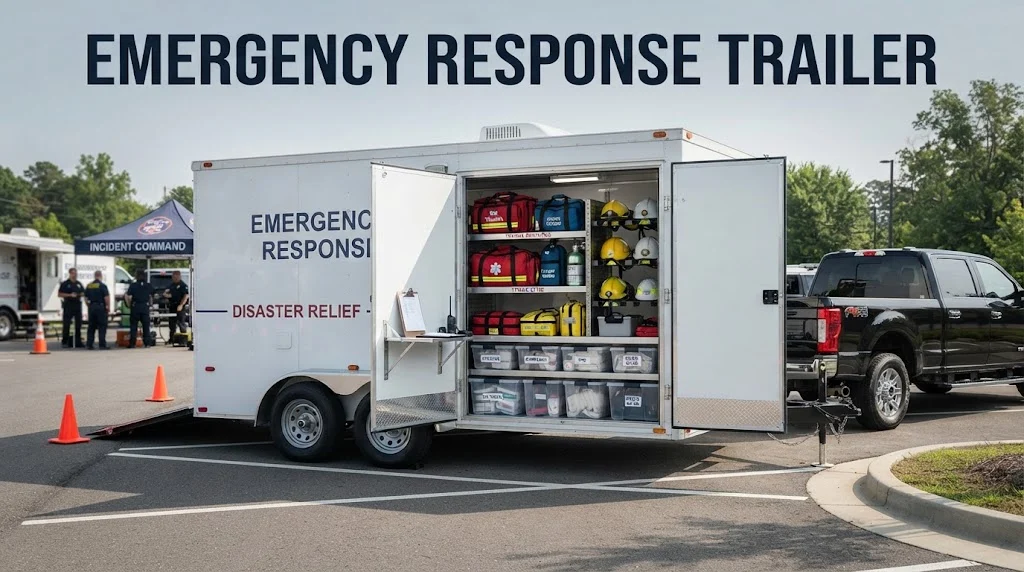
An emergency response trailer is a towable platform designed to carry equipment and supplies for emergency operations. It can range from a small single-axle utility trailer to a large dual-axle command unit with generators, lighting towers, and climate control.
The defining feature is readiness. Unlike a storage container or a warehouse shelf, a trailer is built to move. It can be parked at a staging area, towed behind a pickup truck, or positioned at a command post within minutes.
Most trailers serve one of two roles. Some are supply caches, carrying medical supplies, food, water, and tools. Others are operational hubs, providing power, communications, and workspace for incident command. Many combine both functions in a single unit.
The size and complexity depend entirely on the mission. A volunteer fire department might need a basic first aid and rehab trailer. A city emergency management agency might need a mobile command center with satellite links and a generator.
Types of Emergency Response Trailers
Not every trailer serves the same purpose. Knowing the common types helps you decide what fits your organization.
- Medical and first aid trailers. Stocked with trauma supplies, cots, oxygen, and triage equipment. Used at mass gatherings, disasters, and remote worksites.
- Command and communications trailers. Equipped with radios, satellite phones, maps, monitors, and workstations. Serve as a mobile incident command post.
- Rehab trailers. Provide rest, cooling, and hydration for responders during extended incidents. Common at fire scenes and search operations.
- Supply and logistics trailers. Carry food, water, blankets, cots, and hygiene kits for displaced populations.
- Specialized hazard trailers. Carry hazmat suits, decontamination equipment, absorbents, and containment supplies.
- Generator and lighting trailers. Provide power and scene lighting for night operations or grid-down situations.
- Mobile kitchen trailers. Used for feeding large response teams or affected communities over multiple days.
Some organizations combine two or three functions into one trailer. That saves money but adds weight and reduces specialization. The tradeoff is worth it for smaller teams with limited storage space.
Key Features to Look For
When you evaluate an emergency response trailer, think about how it will be used in the worst conditions. That is when design choices matter most.
Axle and suspension. A single axle works for light loads on paved roads. Dual axles handle heavier loads and rough terrain better. Torsion suspension smooths the ride and protects sensitive equipment.
Hitch type. Ball hitches are common and easy to use. Pintle hitches handle heavier loads and rougher conditions. Choose based on your towing vehicles and expected terrain.
Brakes. Electric brakes are standard for larger trailers. Surge brakes work well for smaller units. Never skip brakes on a trailer that will carry significant weight.
Lighting. Interior LED lighting is essential for night operations. Exterior scene lighting helps with loading and perimeter work. A light tower is a major upgrade for command trailers.
Power. A built-in generator, battery bank, or solar panel keeps equipment running. Plan for at least 8 to 12 hours of off-grid power if the trailer will operate independently.
Climate control. Heating and air conditioning protect medications, electronics, and people. In extreme climates, this is not optional.
Storage and organization. Shelving, cabinets, and labeled bins make supplies findable under pressure. Modular systems let you swap loadouts for different missions.
Security. Locking doors, tamper-resistant latches, and GPS tracking protect your investment. A trailer that sits unattended at a staging area is a target.
Weight and towing. Know the loaded weight before you buy. Make sure your tow vehicle can handle it, including tongue weight and gross trailer weight.
Essential Equipment and Supplies
What goes inside depends on the trailer’s mission. However, most emergency response trailers share a core set of supplies.
Medical and trauma:
- Trauma bags with tourniquets, chest seals, and hemostatic gauze
- AED and spare pads
- Oxygen tanks and delivery devices
- Cots, blankets, and pillows
- Triage tags and patient tracking forms
- Personal protective equipment: gloves, masks, gowns, eye protection
Tools and equipment:
- Hand tools: shovels, pry bars, hammers, bolt cutters
- Power tools with spare batteries
- Tarps, rope, and paracord
- Duct tape, zip ties, and bungee cords
- Fire extinguishers rated for multiple hazard types
- Gas shutoff tools and utility keys
Communication:
- Two-way radios with spare batteries
- Satellite phone or messenger
- Portable cell signal booster
- Paper maps and laminated contact lists
- Whiteboard or flip chart for planning
Power and lighting:
- Portable generator with fuel
- Extension cords and power strips
- LED work lights and headlamps
- Battery bank and charging cables
Logistics and comfort:
- Water: one gallon per person per day
- Non-perishable food and snacks
- Portable toilet or sanitation supplies
- Hand sanitizer and hygiene kits
- Folding tables and chairs
- Pop-up canopy for shade or shelter
Documentation:
- Incident command forms
- Equipment inventory list
- Maintenance log
- Standard operating procedures
Pack items in labeled bins or bags. When everything has a home, anyone can find it. That matters when you are tired, stressed, and working in the dark.
Building vs Buying an Emergency Response Trailer
You have two paths: buy a pre-built unit or build one yourself. Each has tradeoffs.
Buying a pre-built trailer saves time and reduces guesswork. Reputable vendors design units for specific missions. They know the weight limits, wiring requirements, and storage layouts. The trailer arrives ready to deploy. The downside is cost. A fully equipped command trailer can run well into six figures. Even a basic medical trailer costs more than a DIY build.
Building your own gives you control over every detail. You can match the trailer to your exact needs and budget. You can add equipment over time as funds allow. The downside is complexity. You need to manage wiring, weight distribution, weatherproofing, and safety compliance. Mistakes can be expensive or dangerous.
A middle path works well for many organizations. Buy a quality shell trailer with the right axles, brakes, and power setup. Then outfit the interior yourself with shelving, equipment, and supplies. This balances cost, control, and safety.
Whichever route you choose, start with a needs assessment. List the incidents you are most likely to face and List the supplies those incidents require. List the people who will use the trailer. That list becomes your specification.
How to Deploy an Emergency Response Trailer
A trailer that never leaves the lot is not a response asset. It is a storage unit. Deployment is where the value shows up.
Pre-deployment planning:
- Identify who can tow the trailer
- Confirm tow vehicle compatibility
- Map primary and alternate routes
- Designate staging locations
- Assign a trailer manager
- Set a notification and callout process
On arrival:
- Position the trailer for safe access and egress
- Level and chock the wheels
- Connect power if available; start generator if not
- Set up exterior lighting
- Open and organize the working area
- Brief the team on equipment locations
During operations:
- Track supplies used
- Log equipment issues
- Keep the trailer organized
- Maintain communication with command
- Rotate personnel for rest and rehab
After the incident:
- Account for all equipment
- Restock used supplies
- Clean and inspect the trailer
- Refuel and recharge
- Document lessons learned
- Report damage or needed repairs
Drill this process before a real event. A dry run exposes problems while the stakes are low. Time the setup. Look for bottlenecks. Fix them.
Maintenance and Readiness
An emergency response trailer needs regular care. Neglect shows up at the worst time.
Monthly checks:
- Tire pressure and tread depth
- Battery charge on all devices
- Fuel levels and stabilizer
- Generator run test
- Lights and brake function
- Inventory spot check
Quarterly checks:
- Full inventory audit
- Medication expiration review
- Food and water rotation
- Lubrication of moving parts
- Hitch and safety chain inspection
- Weather seal inspection
Annual checks:
- Bearing repack or replacement
- Brake inspection and adjustment
- Full electrical system test
- Trailer registration and inspection
- Comprehensive training refresher
Keep a log inside the trailer. Every check, every restock, every repair gets a line. The log tells you what is ready and what is not.
Assign one person as the trailer manager. That person owns readiness. Without a single owner, maintenance becomes everyone’s job and no one’s responsibility.
Budgeting for an Emergency Response Trailer
Costs vary widely based on size, features, and equipment. A basic used utility trailer with minimal supplies might cost a few thousand dollars. A new custom-built command trailer with generator, HVAC, and communications gear can exceed $100,000.
Break your budget into categories:
- Trailer shell and chassis
- Power system (generator, batteries, solar)
- Climate control
- Interior build-out (shelving, cabinets, workstations)
- Communications equipment
- Medical supplies
- Tools and equipment
- Consumables (food, water, fuel)
- Training and drilling
- Maintenance and insurance
Funding sources for public agencies often include homeland security grants, emergency management grants, and community foundation grants. Private organizations may fundraise or seek corporate sponsorships.
Do not forget recurring costs. Fuel, supplies, maintenance, insurance, and storage add up every year. A trailer is a long-term commitment, not a one-time purchase.
Training Your Team
Equipment does not respond. People do. Your team needs to know how to tow, set up, operate, and restock the trailer.
Start with basic towing training. Anyone who might pull the trailer should practice backing, turning, and parking. Towing a trailer is a skill, and it fades without use.
Next, cover setup and breakdown. Time the process. Aim for a consistent, repeatable sequence that anyone on the team can execute.
Then train on the equipment inside. How does the generator start? Where is the AED? How do you deploy the light tower? Where are the trauma supplies?
Finally, run scenario drills. Simulate a real incident. Deploy the trailer. Use the equipment. Restock it. Debrief afterward. Every drill reveals something the manual missed.
Cross-train at least two people for every critical role. If the primary trailer manager is unavailable, someone else must step in.
Common Mistakes
Buying a trailer without a needs assessment. A good deal on a used trailer means nothing if it does not fit your mission. Define your requirements first.
Overloading the trailer. Every trailer has a gross vehicle weight rating. Exceeding it is dangerous and illegal. Weigh your loaded trailer before you deploy.
Skipping maintenance. A trailer that sits unused for months will have dead batteries, flat spots on tires, and stale fuel. Set a schedule and follow it.
Storing supplies without inventory control. If you do not know what is inside, you do not know what is missing. Use a checklist and update it after every use.
Forgetting the tow vehicle. A trailer is useless without something to pull it. Confirm your tow vehicle can handle the loaded weight, including hitch and tongue capacity.
No designated manager. When everyone owns the trailer, no one does. Assign one person to keep it ready.
Ignoring climate effects. Heat destroys medications and electronics. Cold cracks seals and drains batteries. Protect your investment with proper storage and climate control.
Failing to drill. A trailer that has never been deployed is an untested system. Drill regularly and fix what breaks.
FAQs
How much does an emergency response trailer cost?
A basic used trailer with minimal supplies can cost a few thousand dollars. A new custom-built command trailer with generator, HVAC, and communications equipment can exceed $100,000. Most organizations spend between $15,000 and $60,000 for a well-equipped unit. Equipment, training, and maintenance add to the total cost of ownership.
What size trailer do I need?
Size depends on your mission and your tow vehicle. A small single-axle trailer works for basic medical or supply loads. A dual-axle trailer handles heavier equipment and rougher terrain. Measure your equipment, estimate the loaded weight, and choose a trailer with at least 20 percent capacity to spare.
Can I tow an emergency response trailer with a standard pickup truck?
Many trailers are designed for half-ton or three-quarter-ton pickups. Check the trailer’s gross vehicle weight rating and your truck’s towing capacity. Also check tongue weight, payload, and hitch class. A properly equipped half-ton truck can pull a surprisingly large trailer, but never exceed the manufacturer’s ratings.
What is the difference between an emergency response trailer and a mobile command center?
A mobile command center is typically a larger vehicle, often a converted bus, RV, or box truck. It provides workspace, communications, and coordination for incident leadership. An emergency response trailer is smaller, towable, and often focused on supplies, medical care, or rehab. Some trailers serve as command posts, but they are usually more compact than a full command vehicle.
How often should I inspect my emergency response trailer?
Inspect the trailer monthly for tires, lights, brakes, and battery charge. Do a full inventory and supply check quarterly. Perform a comprehensive annual inspection including bearings, brakes, and electrical systems. After every deployment, restock and inspect before returning the trailer to ready status.
Do I need a special license to tow an emergency response trailer?
In most places, no special license is required for trailers under a certain weight. However, larger trailers may require a commercial driver’s license or an endorsement. Check your local regulations. Even when no license is required, hands-on towing practice is essential for safe operation.
What should I do if the trailer breaks down during deployment?
Have a backup plan. Know which other vehicles or trailers can carry critical supplies. Keep a basic repair kit in the tow vehicle. Maintain a list of nearby repair shops. If the trailer is disabled, transfer essential equipment to another vehicle and continue the mission. Repair the trailer after the incident.
How do I keep supplies from expiring in storage?
Rotate your stock. Use a first-in, first-out system. Check expiration dates quarterly. Replace items before they expire. For medications and food, keep a small buffer and cycle it into regular use. For batteries, store them in a cool, dry place and test them regularly. A simple spreadsheet or logbook makes rotation easy.
Conclusion
An emergency response trailer turns scattered supplies into a ready-to-deploy system. It saves time, reduces chaos, and puts critical resources where they are needed. Build it around your real risks, equip it for your actual missions, and keep it maintained. A trailer that is ready today is worth more than a perfect plan for tomorrow.
Read More Related Articles :
- 150+ Best Responses To Security Detection And Response That Actually Convert In 2026
- 150+ Best Responses To Network Detection Response That Actually Convert In 2026
- 150+ Best Responses To Security Incident Response AI Agent That Actually Convert In 2026

Robert Bennett is a passionate writer and blogger who turns everyday ideas into engaging stories and thoughtful insights.
Writing for RespondLabs.com, he brings a clear, relatable voice to topics that matter.