Quick Answer
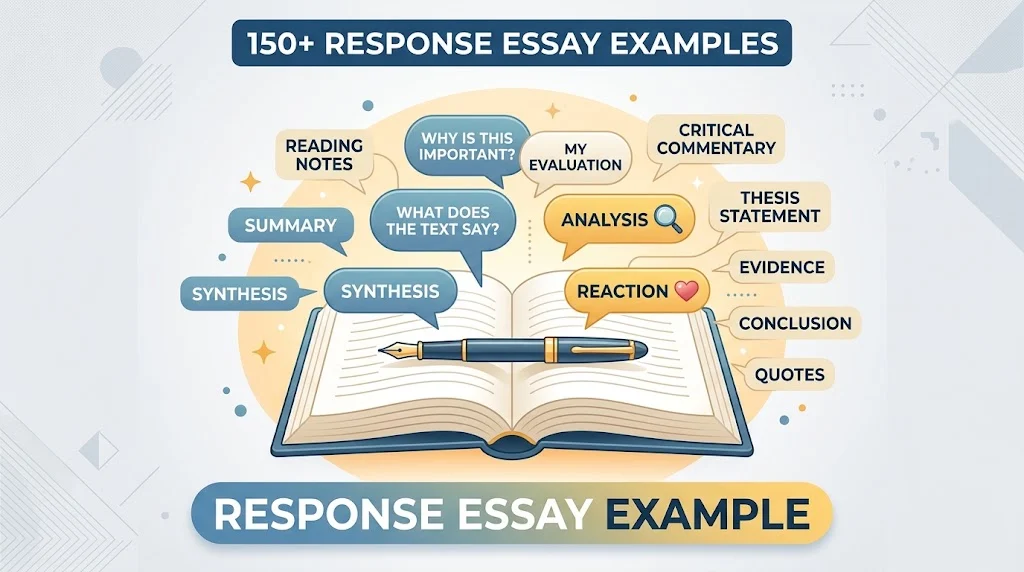
A response essay is a piece of writing where you share your thoughts and reactions to something you read, watched, or experienced. It combines summary, analysis, and personal opinion.
Top response essay examples: Reaction essay, reader response essay, critical response essay, personal response essay, analytical response essay.
Ever had a teacher say “write a response essay” and you just stared at the blank page? Yeah, been there. A response essay sounds simple until you actually sit down to write one. Do you summarize? The “response essay example” question comes up constantly because most students and writers want a clear model to follow. The good news is a response essay is basically a structured reaction. You read something, watch something, or experience something, and then you explain what you think and why. It blends summary with personal insight and a little analysis. This guide breaks down what a response essay is, how to write one, and gives you tons of examples for every type so you can finally stop overthinking and start writing.
What Is A Response Essay?
A response essay is a type of writing where you react to a source like an article, book, movie, speech, or event. It usually has three main parts. First, a brief summary of the source so your reader knows what you are responding to. Second, your personal reaction, which includes your thoughts, feelings, and opinions. Third, analysis that explains why you reacted that way, often using evidence from the text or your own experience. Unlike a research paper, a response essay is personal. Unlike a diary entry, it is structured and thoughtful. The goal is to show you engaged with the material and can explain your perspective clearly.
Types Of Response Essays
Reader response essay: Focuses on your personal reaction to a text.
Critical response essay: Analyzes the strengths and weaknesses of a source.
Personal response essay: Centers on your own experience and emotions.
Analytical response essay: Breaks down how the source works and why.
Argumentative response essay: Takes a position and defends it.
Reflective response essay: Explores how the source changed your thinking.
Compare and contrast response essay: Compares the source to another work.
Evaluative response essay: Judges the quality and effectiveness of the source.
Funny Response Essay Examples
“My response to the article was mostly confusion, then hunger.”
Example: Used as a hook in a lighthearted essay.
Meaning: You are setting a relatable and funny tone.
“I laughed, I cried, I checked my phone twice.”
Example: Used to describe your reaction to a movie.
Meaning: You are being honest and humorous.
“The author made great points, but I was still thinking about lunch.”
Example: Used in a casual personal response.
Meaning: You are balancing honesty with humor.
“This book changed my life, or at least my weekend.”
Example: Used as a witty opening line.
Meaning: You are downplaying a big claim for laughs.
“My reaction was simple. I closed the tab and took a nap.”
Example: Used in a response to an overwhelming article.
Meaning: You are being funny about your limits.
“I agreed with everything until the last paragraph, and then I lost it.”
Example: Used as a dramatic turn in your essay.
Meaning: You are adding humor to your critique.
“The speech was inspiring. My response was to procrastinate harder.”
Example: Used as a self aware joke.
Meaning: You are pointing out the irony.
“I wanted to love this movie. I really did. But here we are.”
Example: Used as a funny disappointment line.
Meaning: You are setting up a critical review.
“My notes for this essay were 90 percent snack breaks.”
Example: Used as a relatable admission.
Meaning: You are being honest about your process.
“The article was five stars. My attention span was one.”
Example: Used as a witty opener.
Meaning: You are joking about focus struggles.
“I highlighted so much I basically colored the whole page.”
Example: Used to describe your engagement.
Meaning: You are showing enthusiasm with humor.
“My response essay is basically a love letter with footnotes.”
Example: Used in a positive response.
Meaning: You are being playful about your admiration.
Sassy Response Essay Examples
“The author had a lot to say. Too bad most of it was wrong.”
Example: Used as a bold opening in a critical essay.
Meaning: You are setting a confident tone.
“I wanted to agree, but my brain refused.”
Example: Used in a sassy critique.
Meaning: You are being playful about disagreement.
“This article was bold, and by bold I mean reckless.”
Example: Used as a sharp critique.
Meaning: You are using humor to make a point.
“The writer made one good point. I will let you guess which one.”
Example: Used in a cheeky review.
Meaning: You are being sarcastic about the source.
“I have never rolled my eyes so hard at a conclusion.”
Example: Used in a critical response.
Meaning: You are expressing strong disagreement.
“This book was a journey, and I want a refund.”
Example: Used as a funny critique.
Meaning: You are being witty about disappointment.
“The argument was strong until it fell apart completely.”
Example: Used as a sassy transition.
Meaning: You are setting up your critique.
“I highlighted the errors for fun.”
Example: Used in a confident response.
Meaning: You are showing you paid close attention.
“The author and I are not on speaking terms.”
Example: Used as a humorous line.
Meaning: You are joking about your disagreement.
“This essay made me feel things. Mostly confusion.”
Example: Used as a witty reaction.
Meaning: You are being honest with attitude.
“I would summarize this, but it would take less time to read it.”
Example: Used in a sharp critique.
Meaning: You are pointing out its lack of depth.
“My response is simple. Next.”
Example: Used as a bold ending line.
Meaning: You are being dismissive in a funny way.
Flirty Response Essay Examples
“I did not expect to fall in love with a poem today, but here we are.”
Example: Used in a romantic response to literature.
Meaning: You are expressing unexpected affection.
“This character has my whole heart and I am not sorry.”
Example: Used in a passionate response essay.
Meaning: You are showing strong emotional attachment.
“Reading this felt like the author was talking directly to me.”
Example: Used in a personal response.
Meaning: You are expressing connection with the text.
“I blushed at a paragraph. Make of that what you will.”
Example: Used in a playful response.
Meaning: You are being charmingly honest.
“This line lives in my head rent free now.”
Example: Used in a trendy response essay.
Meaning: You are showing how much it stuck with you.
“I would write a whole love letter to this ending.”
Example: Used in a positive response.
Meaning: You are expressing deep admiration.
“The chemistry between these characters was unreal.”
Example: Used in a response to a novel or show.
Meaning: You are highlighting emotional connection.
“I fell for the plot twist harder than the main character did.”
Example: Used in a dramatic response.
Meaning: You are being playful about your reaction.
“This essay made me feel seen in a way I did not expect.”
Example: Used in a heartfelt response.
Meaning: You are expressing deep emotional resonance.
“I am not crying, I am just emotionally invested.”
Example: Used in a sentimental response.
Meaning: You are admitting the emotional impact.
“The author wrote this for me specifically, I am convinced.”
Example: Used in a warm response.
Meaning: You are expressing strong personal connection.
“I would read this a hundred times and still feel butterflies.”
Example: Used in a romantic response.
Meaning: You are showing lasting affection for the text.
Polite Response Essay Examples
“This article offered a thoughtful perspective that I appreciate.”
Example: Used in a respectful response essay.
Meaning: You are acknowledging the source kindly.
“I found the author’s argument clear and well supported.”
Example: Used in a balanced response.
Meaning: You are giving credit where it is due.
“While I see the author’s point, I respectfully disagree.”
Example: Used in a courteous critique.
Meaning: You are being polite while sharing your view.
“Thank you for this piece. It gave me a lot to consider.”
Example: Used as a warm opening.
Meaning: You are showing gratitude.
“The essay was informative and easy to follow.”
Example: Used in a positive response.
Meaning: You are being complimentary.
“I appreciate the research behind this article.”
Example: Used in a respectful review.
Meaning: You are acknowledging their effort.
“This was a well written piece with strong points.”
Example: Used in a polite response.
Meaning: You are giving balanced praise.
“I agree with the main idea, though I would add one thing.”
Example: Used in a constructive response.
Meaning: You are being respectful while contributing.
“The author made me think differently, and I value that.”
Example: Used in a mature response.
Meaning: You are showing openness.
“Thank you for sharing this perspective.”
Example: Used in a kind reply.
Meaning: You are being gracious.
“This piece was thought provoking and well structured.”
Example: Used in a formal response.
Meaning: You are giving polite praise.
“I enjoyed reading this and found it meaningful.”
Example: Used in a simple polite response.
Meaning: You are being sincere and courteous.
Professional Response Essay Examples
“The author effectively uses evidence to support the central claim.”
Example: Used in an academic response essay.
Meaning: You are analyzing structure professionally.
“This article presents a compelling argument backed by data.”
Example: Used in a formal response.
Meaning: You are evaluating credibility.
“The methodology is sound, though the sample size is limited.”
Example: Used in a research response.
Meaning: You are offering balanced critique.
“The writer demonstrates strong command of the subject.”
Example: Used in an academic setting.
Meaning: You are acknowledging expertise.
“While the argument is valid, it overlooks counterpoints.”
Example: Used in a critical analysis.
Meaning: You are showing academic rigor.
“The essay’s structure enhances its overall clarity.”
Example: Used in a formal review.
Meaning: You are analyzing writing quality.
“The evidence provided is relevant and well organized.”
Example: Used in a scholarly response.
Meaning: You are evaluating support.
“The conclusion follows logically from the argument.”
Example: Used in an academic response.
Meaning: You are assessing coherence.
“This piece contributes meaningfully to the discussion.”
Example: Used in a professional review.
Meaning: You are acknowledging value.
“The author’s tone is appropriate for the intended audience.”
Example: Used in a formal critique.
Meaning: You are analyzing style.
“The sources cited are credible and current.”
Example: Used in an academic response.
Meaning: You are evaluating research quality.
“Overall, the essay is well reasoned and persuasive.”
Example: Used in a professional summary.
Meaning: You are giving a balanced conclusion.
Creative Response Essay Examples
“Reading this felt like walking through someone else’s dream.”
Example: Used in a poetic response.
Meaning: You are using imagery to describe your reaction.
“The author painted a picture I could not look away from.”
Example: Used in an artistic response.
Meaning: You are praising vivid writing.
“This essay was a mirror I did not know I needed.”
Example: Used in a reflective response.
Meaning: You are showing personal impact.
“The words danced off the page and into my thoughts.”
Example: Used in a lyrical response.
Meaning: You are describing the writing beautifully.
“I felt like I was having a conversation with the author.”
Example: Used in a personal response.
Meaning: You are showing connection.
“The story wrapped around me like a warm blanket.”
Example: Used in a cozy response.
Meaning: You are expressing comfort.
“This piece was a rollercoaster I willingly got on.”
Example: Used in an energetic response.
Meaning: You are describing emotional ups and downs.
“The ending hit me like a plot twist I should have seen coming.”
Example: Used in a dramatic response.
Meaning: You are expressing surprise.
“Reading this was like finding a song that fits your mood exactly.”
Example: Used in a relatable response.
Meaning: You are showing resonance.
“The author’s voice echoed in my head for days.”
Example: Used in a lasting response.
Meaning: You are showing lingering impact.
“This essay opened a door I did not know was closed.”
Example: Used in a transformative response.
Meaning: You are expressing new awareness.
“The writing was so vivid I could smell the pages.”
Example: Used in a sensory response.
Meaning: You are praising immersive writing.
Sarcastic Response Essay Examples
“This article was enlightening, if enlightenment means confusion.”
Example: Used as a witty critique.
Meaning: You are being sarcastic about clarity.
“I loved how the author avoided the actual topic.”
Example: Used in a dry response.
Meaning: You are pointing out avoidance with humor.
“The argument was so strong it collapsed under its own weight.”
Example: Used in a sharp critique.
Meaning: You are being sarcastic about logic.
“I appreciated the author’s commitment to being wrong.”
Example: Used as a bold line.
Meaning: You are being cheeky about errors.
“This piece was unforgettable, mostly because I tried to forget it.”
Example: Used in a funny review.
Meaning: You are being dry and witty.
“The conclusion was bold, if bold means unsupported.”
Example: Used in a critical essay.
Meaning: You are pointing out weak reasoning.
“I have never seen so many words say so little.”
Example: Used as a sassy summary.
Meaning: You are critiquing lack of substance.
“The author’s bias was subtle, like a neon sign.”
Example: Used in a sarcastic response.
Meaning: You are calling out obvious partiality.
“This essay was a masterclass in missing the point.”
Example: Used in a sharp review.
Meaning: You are being witty about failure.
“I would summarize this, but I am still looking for the main idea.”
Example: Used as a funny critique.
Meaning: You are pointing out lack of clarity.
“The writing was clear, if clear means see through.”
Example: Used in a dry response.
Meaning: You are being sarcastic about depth.
“I am sure the author meant well, and that is all I will say.”
Example: Used as a polite but sarcastic ending.
Meaning: You are being cheeky and restrained.
Cute Response Essay Examples
“This piece made my heart happy.”
Example: Used in a sweet response.
Meaning: You are expressing warm feelings.
“I smiled the whole time I was reading this.”
Example: Used in a positive response.
Meaning: You are showing genuine joy.
“This essay felt like a hug.”
Example: Used in a cozy response.
Meaning: You are describing comfort.
“I wanted to highlight every line.”
Example: Used in an enthusiastic response.
Meaning: You are showing how much you loved it.
“The author’s words felt like sunshine.”
Example: Used in a warm response.
Meaning: You are giving a sweet compliment.
“I am keeping this essay in my favorites forever.”
Example: Used in a loving response.
Meaning: You are expressing lasting affection.
“This piece made me feel understood.”
Example: Used in a heartfelt response.
Meaning: You are showing personal connection.
“I wish I could thank the author in person.”
Example: Used in a grateful response.
Meaning: You are expressing appreciation.
“Reading this felt like a warm cup of tea.”
Example: Used in a cozy response.
Meaning: You are describing comfort.
“This essay is a little treasure.”
Example: Used in a sweet review.
Meaning: You are giving warm praise.
“I am so glad I read this today.”
Example: Used in a happy response.
Meaning: You are expressing simple joy.
“This piece reminded me why I love reading.”
Example: Used in a loving response.
Meaning: You are showing deep appreciation.
Dramatic Response Essay Examples
“This essay shattered me and then put me back together.”
Example: Used in an intense response.
Meaning: You are showing emotional impact.
“I was not ready for the emotional damage this caused.”
Example: Used in a dramatic review.
Meaning: You are expressing strong feelings.
“The ending destroyed me in the best way.”
Example: Used in a passionate response.
Meaning: You are showing deep engagement.
“I gasped out loud at the final paragraph.”
Example: Used in a shocked response.
Meaning: You are describing a strong reaction.
“This piece took me on an emotional rollercoaster.”
Example: Used in a dramatic summary.
Meaning: You are expressing intense ups and downs.
“I will be thinking about this for the rest of my life.”
Example: Used in an over the top response.
Meaning: You are emphasizing lasting impact.
“The author ripped my heart out and I said thank you.”
Example: Used in a dramatic review.
Meaning: You are showing emotional investment.
“I cried, I laughed, I questioned everything.”
Example: Used in a passionate response.
Meaning: You are describing a full emotional journey.
“This essay changed me as a person.”
Example: Used in a transformative response.
Meaning: You are emphasizing deep impact.
“The words hit me like a truck.”
Example: Used in an intense reaction.
Meaning: You are describing a powerful effect.
“I am still recovering from that conclusion.”
Example: Used in a dramatic response.
Meaning: You are showing lingering emotion.
“This piece deserves a standing ovation.”
Example: Used in an enthusiastic review.
Meaning: You are giving high praise with drama.
Chill And Casual Response Essay Examples
“This was a solid read.”
Example: Used in a relaxed response.
Meaning: You are giving simple praise.
“I liked it. It made sense.”
Example: Used in a casual review.
Meaning: You are keeping it easy.
“Good points, easy to follow.”
Example: Used in a chill response.
Meaning: You are acknowledging clarity.
“It was interesting. I would read more from this author.”
Example: Used in a laid back review.
Meaning: You are showing mild interest.
“Solid argument, no complaints.”
Example: Used in a simple response.
Meaning: You are giving straightforward feedback.
“I enjoyed it. Short and sweet.”
Example: Used in a casual response.
Meaning: You are praising brevity.
“Not bad at all. I would recommend it.”
Example: Used in a relaxed review.
Meaning: You are giving light praise.
“It was a good read. Nothing too wild.”
Example: Used in a chill response.
Meaning: You are being honest and calm.
“Decent points. I agree with most of it.”
Example: Used in a casual critique.
Meaning: You are showing partial agreement.
“It was fine. I would read it again.”
Example: Used in a simple response.
Meaning: You are giving mild approval.
“Cool read. I liked the ending.”
Example: Used in a relaxed review.
Meaning: You are highlighting a favorite part.
“Solid piece. Would recommend.”
Example: Used in a quick response.
Meaning: You are giving a short endorsement.
Confident Response Essay Examples
“The author’s argument is strong, and I fully agree.”
Example: Used in a bold response.
Meaning: You are showing conviction.
“This essay confirms what I have always believed.”
Example: Used in a confident review.
Meaning: You are affirming your stance.
“The evidence is clear, and the conclusion is undeniable.”
Example: Used in a strong response.
Meaning: You are expressing certainty.
“I stand with the author on every point.”
Example: Used in a supportive response.
Meaning: You are showing full agreement.
“This piece is convincing and well argued.”
Example: Used in a confident review.
Meaning: You are praising effectiveness.
“The author makes a compelling case.”
Example: Used in a strong response.
Meaning: You are acknowledging persuasive writing.
“I am convinced, and I think others should be too.”
Example: Used in a confident endorsement.
Meaning: You are showing firm belief.
“The logic here is airtight.”
Example: Used in a bold review.
Meaning: You are praising reasoning.
“This is exactly how this topic should be handled.”
Example: Used in a confident response.
Meaning: You are expressing approval.
“The essay delivers on every promise it makes.”
Example: Used in a strong review.
Meaning: You are showing satisfaction.
“I would defend this argument anywhere.”
Example: Used in a bold response.
Meaning: You are showing commitment.
“This piece is a winner, no debate needed.”
Example: Used in a confident close.
Meaning: You are ending with certainty.
FAQs
What is a response essay example?
A response essay example is a model or sample that shows how to summarize a source and share your personal reaction and analysis in a structured way.
How do I start a response essay?
Start with a brief summary of the source, then introduce your main reaction or opinion in a clear thesis statement.
What should a response essay include?
It should include a summary, your personal reaction, analysis with evidence, and a conclusion that ties your thoughts together.
What is the difference between a response essay and a summary?
A summary just restates what the source says. A response essay adds your thoughts, feelings, and analysis.
Can a response essay be informal?
It depends on the assignment. Some response essays are personal and casual, while others require a formal academic tone.
Conclusion
A response essay is your chance to talk back to a text, a movie, a speech, or an idea. It is personal, structured, and powerful when done right. The key is to summarize briefly, react honestly, and explain why you feel the way you do. Whether you go funny, critical, emotional, or professional, the right approach makes your writing stand out. So the next time you get assigned a response essay, do not panic. Pick a type, grab an example, and start writing with confidence. Save this guide for your next assignment, share it with a classmate who needs it, and go turn your reactions into writing that actually hits.Read More Related Articles :
Read More Related Articles :
- 350+ Empathic Response Examples | Thoughtful, Caring & Supportive Replies In 2026
- 350+ Definitions Of Response | That Actually Make Sense (With Examples and Replies)In 2026
- 350+ “Behaviors Are Responses To Needs | Quotes, Insights And Replies That Actually Hit In 2026

Sarah Mitchell is a blogger and writer at RespondLabs.com, turning everyday ideas into clear, engaging stories.
She enjoys exploring fresh perspectives and creating content that keeps readers curious and informed.
1 thought on “350+ Response Essay Examples | Easy Formats, Ideas & Writing Tips In 2026”