Quick Answer
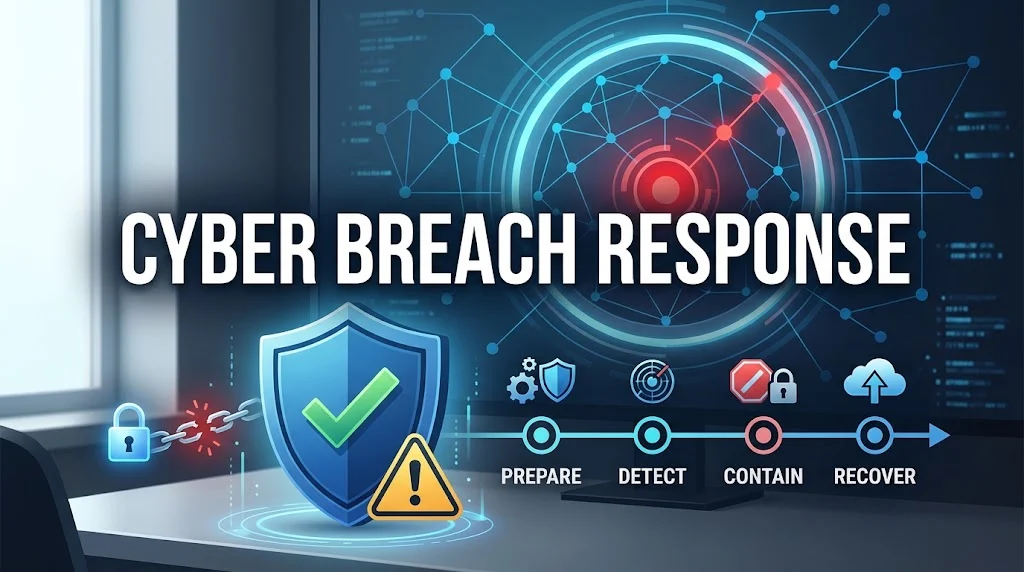
Cyber breach response is the structured process of detecting, containing, and recovering from a security incident. The NIST SP 800-61 framework defines four phases: preparation, detection and analysis, containment and recovery, and post-incident activity. Organizations with tested response plans save over $1.5 million per breach.
A cyber breach does not announce itself. It starts quietly. An attacker gains access through a stolen credential, an unpatched vulnerability, or a compromised vendor. They move laterally and they escalate privileges. They exfiltrate data. By the time your team notices, the damage is already spreading.
How you respond in the first hours determines whether the incident becomes a contained event or a catastrophic breach. IBM’s 2026 Cost of a Data Breach Report found that organizations took an average of 183 days to identify a breach and another 64 days to contain it. That is 247 days of an attacker operating inside your environment.
Cyber breach response is not a plan you write after an attack. It is a capability you build beforehand. It requires preparation, clear roles, tested procedures, and disciplined execution. This guide covers the full incident response lifecycle, from preparation through post-incident review. It includes communication templates, legal notification requirements, and the most common mistakes that derail response efforts.
What Is Cyber Breach Response?
Cyber breach response is the structured process of identifying, investigating, and remediating a security incident. It aligns with the NIST SP 800-61 framework, which defines four phases: preparation, detection and analysis, containment and recovery, and post-incident activities.
The goal is simple: minimize the time an attacker can operate inside your environment. That window, often called dwell time, determines the scope of the damage. Mandiant’s M-Trends 2026 report puts the global median dwell time at 14 days, up from 11 days the year before. In cyber espionage cases, the median dwell time was 122 days.
A well-executed response reduces dwell time, contains the threat, preserves evidence, and restores operations. A poorly executed response extends the damage, destroys forensic evidence, and invites regulatory penalties.
The NIST Incident Response Framework
The NIST framework is the most widely recognized standard for incident response. NIST SP 800-61r3, the latest revision, aligns with the Cybersecurity Framework (CSF) 2.0 and emphasizes a continuous, role-based, and risk-driven approach.
The framework defines four phases:
Preparation. Establish incident response policies, plans, roles, escalation procedures, and communication processes before an incident occurs.
Detection and analysis. Identify that an incident has occurred, determine its scope, and understand how it happened.
Containment, eradication, and recovery. Stop the attack from spreading, remove the threat, and restore normal operations.
Post-incident activity. Review what happened, document lessons learned, and update your plan.
Organizations that follow a structured framework respond faster and more effectively than those that improvise under pressure.
Why Preparation Determines the Outcome
Preparation is the most important phase. Organizations with tested incident response plans save over $1.5 million per breach compared to those without. The difference is not just having a plan on paper. It is having one your team has practiced.
Build an Incident Response Plan
A strong incident response plan covers the full lifecycle. It should include:
- Clear delineation of roles and responsibilities
- Escalation procedures and decision authorities
- Communication processes for internal and external stakeholders
- Regulatory notification requirements and deadlines
- Procedures for evidence preservation and forensic analysis
Keep the core plan under 15 pages. Push scenario detail into separate playbooks. Pre-authorize containment actions at defined severity levels so analysts do not wait on approval.
Build an Incident Response Team
An incident response team is a cross-functional group responsible for managing incidents from detection through recovery. Key roles include:
Incident Commander. The decision-maker and coordinator. Declares the incident, sets severity, makes final calls, and owns communication to leadership.
Technical Lead. Directs investigation and containment. Coordinates the analysts and system owners doing hands-on work.
Forensics Analyst. Focuses on evidence collection and investigation. Preserves volatile data and reconstructs the attack timeline.
Legal Counsel. Ensures the response complies with relevant laws and regulations. Manages attorney-client privilege and regulatory notifications.
Communications Officer. Manages internal and external messaging. Protects brand reputation and coordinates with media relations.
Without clear roles, minor delays multiply into bigger costs. The cost of recovering from a ransomware attack is now, on average, fifty times higher than the ransom itself.
Test Your Plan
Conduct quarterly tabletop exercises using realistic attack scenarios: ransomware, data exfiltration, and third-party breaches. Third-party breaches jumped 60% year over year, reaching 48% of all confirmed incidents. Most tabletop programs ignore this scenario entirely. When the real call comes, they freeze.
The First 24 Hours of Cyber Breach Response
The first hours after detection set the trajectory for everything that follows. Move fast, but do not be reckless.
Step 1: Contain the Breach
Containment stops the attack from spreading. Immediate actions include:
- Isolate affected systems. Disconnect compromised machines from the network to stop lateral movement. Do not shut them down. Just disconnect them.
- Disable compromised accounts. Reset passwords and revoke session tokens for any accounts you know or suspect are compromised. Start with admin and privileged accounts.
- Preserve evidence. Do not reboot compromised systems. Take full forensic images including memory dumps first. Rebooting destroys volatile data that your investigation team needs to trace the attacker’s path.
- Activate your response team. Assign predefined roles: incident commander, technical lead, and legal counsel at minimum.
- Start the documentation clock. Log every action and decision with timestamps. This documentation is critical for regulatory compliance and insurance claims.
Step 2: Assess the Damage
Once the breach is contained, you need to understand what happened. Your notification clock is already running, so assess the damage and prepare notifications in parallel.
Identify the attack vector. How did attackers get in? Exploitation of vulnerabilities has become the most common initial access vector, accounting for 31% of breaches. Credential abuse has declined to 13%.
Determine what data was accessed. Review logs to identify which databases, files, or systems the attacker touched. Categorize the data: was it personal information, financial records, intellectual property, or something else?
Establish the timeline. When did the attacker first gain access? How long were they inside? What did they do while they were there?
Step 3: Communicate
Clear communication during an incident is critical. Pre-approved templates save time and reduce the risk of saying something that creates legal liability.
Internal Status Update
text
[INCIDENT] Severity {n} - {Service Name}
Status: Investigating / Mitigating / Resolved
Impact: {description of user impact}
Current Action: {what team is doing}
Next Update: {time}
Customer Communication
text
We are aware of a security incident that may have affected your data.
Our team is actively investigating and working to resolve it.
We will provide an update by {time}.
Escalation Message
text
Incident {ID} has not been acknowledged within {time}.
Escalating to {contact} for immediate action.
Legal Notification Requirements for Cyber Breaches
Notification deadlines are strict. Missing them can result in regulatory fines and legal liability.
The General Data Protection Regulation (GDPR) requires organizations to notify the supervisory authority within 72 hours of becoming aware of a breach. The SEC gives four business days. Your cyber insurer needs to hear from you immediately or they may deny your claim.
Breach notification laws vary globally but share a common focus on prompt notification. The 72-hour timeframe is very common among countries aligned with the GDPR. In Canada, PIPEDA requires businesses to report breaches posing a “real risk of significant harm” to affected individuals and the federal Privacy Commissioner. In Australia, the Privacy Act requires organizations to notify individuals of breaches likely to result in serious harm, with fines reaching up to AUD 50 million.
Integrate breach notification into your incident response plan. Define notification protocols early, automate workflows where possible, and align messaging with legal and business requirements.
Recovering from a Cyber Breach
Recovery means restoring affected systems and data. It is not just about getting back online. It is about doing so securely.
Restore from verified clean backups. Ensure backups are free from compromise. Test restoration procedures before you need them.
Rebuild compromised resources. Do not reuse compromised systems. Rebuild from known-good templates or infrastructure-as-code.
Rotate credentials and secrets. Assume every credential the attacker could have accessed is compromised. Rotate passwords, API keys, and certificates.
Verify eradication. Before returning to production, confirm the threat has been fully removed. Monitor for signs of re-infection.
Monitor aggressively. After recovery, increase monitoring for weeks or months. Attackers often return.
Post-Incident Activities
Post-incident activities are where organizations learn and improve. Skipping this phase means repeating the same mistakes.
Conduct a lessons learned review. Gather the response team and review what happened. Cover the incident timeline, root cause, what worked, what failed, and gaps in detection, tooling, or process.
Update your incident response plan. Use findings from the review to update your plan. Add new attack scenarios, refine playbooks, and adjust escalation procedures.
Preserve evidence for compliance. Many industries have regulatory requirements for incident documentation. Store evidence in immutable storage and document your chain of custody.
Train and exercise. Use the incident as a training opportunity. Update tabletop scenarios to reflect what you learned.
Common Mistakes in Cyber Breach Response
Even experienced teams make these mistakes. Avoiding them improves outcomes.
Rebooting compromised systems. This destroys volatile memory and forensic evidence. Disconnect from the network instead.
Waiting too long to notify. Notification deadlines are strict. GDPR gives you 72 hours. The SEC gives four business days. Missing them compounds the damage.
Skipping evidence preservation. Without forensic images and logs, you cannot determine what was taken or how the attacker operated.
Improvising under pressure. Most response failures happen because people improvise. They skip steps and destroy evidence. Companies with tested plans contain breaches faster and pay millions less.
Ignoring third-party risks. Breaches involving a vendor, supplier, or service provider reached 48% of all confirmed incidents. Simulate a call to a compromised vendor in your tabletop exercises.
Forgetting about the ransom question. Ransomware appeared in 48% of all confirmed breaches. 69% of victims chose not to pay. The payment decision is one agenda item. Sustaining operations without primary systems, coordinating with legal counsel, and managing customer communications under regulatory deadlines are the decisions that determine survival.
Neglecting post-incident review. Incidents that are not analyzed are incidents that will happen again. Document lessons learned and assign action items.
Cyber Breach Response: Frequently Asked Questions
What is the first step in cyber breach response?
Containment. Isolate affected systems from the network, disable compromised accounts, and preserve forensic evidence. Do not reboot systems, as this destroys volatile data needed for investigation.
How long do organizations have to notify regulators of a breach?
It depends on the jurisdiction. GDPR gives 72 hours from discovery. The SEC gives four business days. Other jurisdictions have deadlines ranging from one hour to 30 days. Know your requirements before an incident occurs.
What is the NIST incident response framework?
NIST SP 800-61 defines four phases: preparation, detection and analysis, containment and recovery, and post-incident activities. The latest revision aligns with the Cybersecurity Framework 2.0.
Who should be on a cyber breach response team?
At minimum: an incident commander, a technical lead, a forensics analyst, legal counsel, and a communications officer. Each role has specific responsibilities during an incident.
How long does it take to detect a cyber breach?
Mandiant puts the median dwell time at 14 days. IBM’s 2026 report found organizations took an average of 183 days to identify a breach and another 64 days to contain it.
What should I do if ransomware encrypts our systems?
Isolate affected systems, disable compromised accounts, and preserve evidence. Do not pay the ransom without consulting legal counsel and law enforcement. 69% of victims chose not to pay in 2026.
How do I preserve evidence during a breach?
Do not reboot compromised systems. Take full forensic images including memory dumps. Export relevant logs to immutable storage. Document the chain of custody for all evidence.
How can I test my cyber breach response plan?
Conduct quarterly tabletop exercises using realistic scenarios: ransomware, data exfiltration, and third-party breaches. Test communication procedures, escalation paths, and decision-making under pressure. Organizations with tested plans save over $1.5 million per breach.
Conclusion
Cyber breach response is not a document you write and forget. It is a capability you build, test, and refine. Prepare with clear roles and tested procedures. Detect quickly and contain aggressively. Preserve evidence and communicate clearly. Recover carefully and learn from every incident. When you master the full lifecycle, you turn a potential catastrophe into a manageable event
Read More Related Articles :
- 350+ Cold Emails That Get Responses | Proven Templates, Tips & Examples In 2026
- 350+ How to Calculate Response Rate | Formula, Examples & Easy Guide In 2026
- 350+ Cold Email Response Rate | Benchmarks, Averages & Ways to Improve In 2026

Sarah Mitchell is a blogger and writer at RespondLabs.com, turning everyday ideas into clear, engaging stories.
She enjoys exploring fresh perspectives and creating content that keeps readers curious and informed.