Quick Answer
An incident response plan template is a structured document that defines how your organization detects, contains, and recovers from security incidents. It includes roles, escalation paths, communication procedures, and regulatory notification requirements. The best templates follow the NIST SP 800-61 framework and are tested through tabletop exercises.
A ransomware note appears on a file server at 2 a.m. on a Saturday. Your on-call technician gets the alert. What happens in the next 15 minutes determines whether this becomes a contained incident or a business-ending disaster. The difference comes down to one thing: whether your team has a tested plan or improvises under pressure.
Cyber incidents do not wait for business hours. They exploit the gaps between preparation and panic. IBM’s 2026 Cost of a Data Breach Report found that organizations took an average of 183 days to identify a breach and another 64 days to contain it. Organizations with a tested incident response plan reduce breach costs by an average of $2.66 million compared to those without one.
An incident response plan template turns that chaos into a repeatable process. It defines who does what, when, and in what order and It removes hesitation during the first critical minutes. It ensures critical actions are not overlooked, from isolating compromised systems to preserving forensic evidence to notifying regulators within legal deadlines.
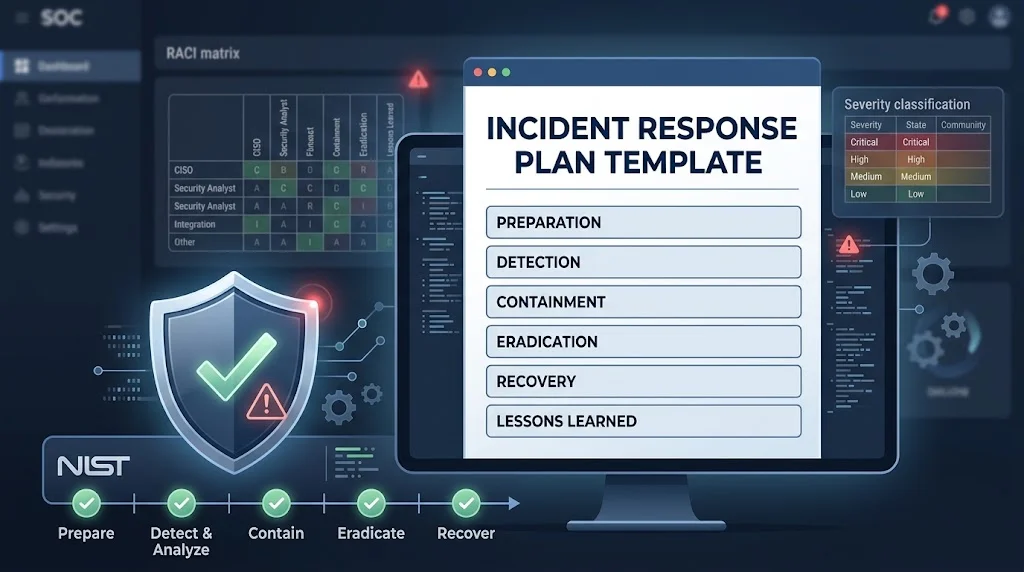
This guide provides a complete, copy-ready template aligned with the NIST SP 800-61 framework. It covers all phases: preparation, detection and analysis, containment, eradication and recovery, and post-incident activity. It includes severity classification criteria, a RACI matrix, communication templates, and regulatory notification deadlines.
What Is an Incident Response Plan?
An incident response plan (IRP) is a formally approved document that defines how your organization prepares for, detects, contains, and recovers from security incidents. The NIST standard describes the IRP as part of a formal, focused, and coordinated incident response capability involving policies, plans, procedures, team structure, and communications that should be documented, implemented, and reviewed regularly.
An IRP is not the same as a playbook. The plan defines the overall strategy, roles, escalation paths, and governance. Playbooks are the tactical, scenario-specific procedures for handling specific incident types: ransomware, phishing, data exfiltration, insider threats. The plan is the umbrella. Playbooks are the details.
Every compliance framework, from HIPAA to CMMC to SOC 2, mandates documented incident response procedures. Beyond compliance, a well-executed response can mean the difference between a contained security event and a catastrophic breach that destroys customer trust, triggers regulatory penalties, and results in litigation.
Why Every Security Team Needs a Template
Over 77% of organizations still lack a formal, consistently applied incident response plan. A template solves the blank-page problem. It gives you a structured starting point that you customize for your environment, your tech stack, your risk profile, and your regulatory obligations.
Organizations that detect breaches internally have breach costs nearly $1 million lower on average than those whose breaches are identified by attackers. The proportion of breaches detected internally has been rising steadily, from 33% in 2023 to 42% in 2024. A tested plan with clear roles and detection coverage that matches your threat model is what separates the two groups.
For a three-to-ten person security team, an IRP clarifies roles, escalation paths, and actions during a crisis. When a SEV-1 fires at 2 a.m. and your on-call engineer is the only person available, they need a clear playbook.
The NIST Incident Response Framework
The NIST framework gives most teams the baseline operating model for incident response. NIST SP 800-61 has been the standard reference for IR planning since its original publication. The four phases provide the baseline operating model for most IR programs.
Preparation. Establish incident response policies, plans, roles, escalation procedures, and communication processes before an incident occurs.
Detection and analysis. Identify that an incident has occurred, determine its scope, and understand how it happened.
Containment, eradication, and recovery. Stop the attack from spreading, remove the threat, and restore normal operations.
Post-incident activity. Review what happened, document lessons learned, and update your plan.
The SANS Institute offers a similar six-step process: preparation, identification, containment, eradication, recovery, and lessons learned. The core phases are the same. NIST groups containment, eradication, and recovery together because they often overlap in practice.
Section 1: Plan Information
Every incident response plan template should begin with basic identification and ownership information. This section establishes accountability and ensures the plan is maintained and reviewed regularly.
text
Organization name: [Company name]
Plan owner: [Name, title]
Version and date: [v1.0, date]
Last tested: [Date of last tabletop exercise]
Next scheduled review: [Date]
Executive approver: [Name, title, signature]
Document ownership matters because plans become stale. Systems change. People leave. Contacts expire. Without a named owner and a review schedule, the plan drifts out of alignment with reality. A plan that references systems that no longer exist and assigns responsibilities to people who left two years ago will not survive contact with an actual incident.
Section 2: Purpose and Scope
This section defines what the plan covers and what it does not. Clear scope prevents confusion during an incident when responders are unsure whether a particular event falls under the plan.
text
This Incident Response Plan (IRP) establishes the framework for detecting, responding to, containing, eradicating, and recovering from cybersecurity incidents affecting [ORGANIZATION NAME]. This plan aligns with NIST SP 800-61 Rev. 3 and the NIST Cybersecurity Framework 2.0.

In Scope:
☐ All information systems owned or operated by [ORGANIZATION NAME]
☐ Cloud-based systems and services
☐ Third-party systems processing organizational data
☐ Employee-owned devices accessing organizational resources (BYOD)
☐ Operational technology (OT) systems

Out of Scope:
☐ [SPECIFY EXCLUSIONS]

A security incident is defined as: [e.g., any confirmed or suspected unauthorized access, data exposure, malware execution, account compromise, or disruption of critical systems]

The following are NOT incidents unless escalated:
☐ Blocked phishing emails
☐ Quarantined malware with no execution
☐ Failed login attempts below threshold
Explicitly defining what does not count as an incident is as important as defining what does. Without clear boundaries, routine events like blocked phishing emails trigger unnecessary escalations, while genuine incidents slip through because responders are unsure whether they qualify.
Section 3: Incident Response Team and Decision Authority
This is the most critical section of any incident response plan template. Every incident response plan must define who is involved and what their specific responsibilities are. A RACI matrix eliminates ambiguity during high-stress situations by assigning four roles for each IR activity: Responsible, Accountable, Consulted, and Informed.
text
Role | Name | Primary Phone | Backup Person | Decision Authority
Incident Commander | [Name] | [Number] | [Name] | Declares incident, sets severity, leads response
IT/Security Lead | [Name] | [Number] | [Name] | Isolates systems, directs technical investigation
Forensics Analyst | [Name] | [Number] | [Name] | Preserves evidence, reconstructs timeline
Legal Counsel | [Name] | [Number] | [Name] | Advises on notification, privilege, regulatory duties
Communications Lead | [Name] | [Number] | [Name] | Manages internal and external messaging
Executive Sponsor | [Name] | [Number] | [Name] | Authorizes major decisions, communicates with board
HR Representative | [Name] | [Number] | [Name] | Handles insider threat and personnel matters
Responsible: The person or team that executes the task. During a ransomware incident, the security engineer who isolates affected systems is Responsible for containment.
Accountable: The single person who makes the decision and owns the outcome. The CISO or VP of Engineering is typically Accountable for incident classification and major response decisions.
Consulted: Subject matter experts who provide input before a decision is made. Legal counsel is Consulted on breach notification decisions.
Informed: Stakeholders who need to know about decisions and progress but are not involved in making them. The CEO, board, and customer success team are Informed at defined intervals.
The RACI must include roles from outside the security team: legal, communications, customer support, human resources, and executive leadership. Incidents that escalate beyond severity level 2 invariably involve non-technical stakeholders, and discovering who should be in the room during an active incident is a preparation failure.
Section 4: Severity Classification
Severity classification determines what resources are activated, what communication cadence is followed, and what escalation timelines apply. Ambiguous severity criteria are the most common failure point in IR plans. Responders waste critical time debating whether an event is a Level 2 or Level 3 instead of executing the plan.
text
SEV-1 (Critical):
Active data exfiltration confirmed, ransomware spreading across systems, complete loss of a production service, or compromise of authentication infrastructure.
Response: All-hands war room within 30 minutes. Executive notification within 1 hour.

SEV-2 (High):
Confirmed unauthorized access to sensitive data, compromise of a privileged account, or malware execution on a critical system.
Response: Response team assembled within 1 hour. Executive notification within 2 hours.

SEV-3 (Medium):
Suspicious activity requiring investigation, malware detected but contained, or a vulnerability discovered but not yet exploited.
Response: Investigation begins within 4 hours. Standard reporting cadence.

SEV-4 (Low):
Policy violation, blocked attack, or minor security event requiring documentation.
Response: Investigated within 24 hours. Documented for review.
Section 5: Phase 1 – Preparation
Preparation is the phase that determines whether everything else works. An organization that has invested in preparation responds to incidents in hours. One that has not responds in weeks, if it detects the incident at all.
Preparation includes:
- Establishing and training the incident response team
- Deploying detection and monitoring tools (SIEM, EDR, NDR)
- Documenting escalation paths and decision authorities
- Pre-contracting external resources: outside counsel, forensics firm, crisis communications
- Configuring evidence preservation capabilities (log retention, forensic imaging tools)
- Running tabletop exercises to validate the plan
Keep the core plan under 15 pages. Push scenario detail into separate playbooks. Pre-authorize containment actions at defined severity levels so analysts do not wait on approval. Conduct quarterly tabletop exercises using realistic attack scenarios: ransomware, data exfiltration, and third-party breaches.
Section 6: Phase 2 – Detection and Analysis
Detection is identifying that an incident may be occurring. Analysis is determining whether the alert is a true positive, what type of incident it is, and what scope is affected.
text
Detection Checklist:
☐ Alert validated (confirmed not a false positive)
☐ Affected systems identified
☐ Incident severity classified (SEV-1 through SEV-4)
☐ Incident Commander notified for SEV-1/SEV-2
☐ Timeline started with first indicator timestamp
☐ Incident type classified: malware, unauthorized access, data exfiltration, denial of service, insider threat
☐ Initial scope determined: which systems, data, and users are affected
☐ Incident log begun: timestamped, factual, maintained throughout
The median dwell time (time from compromise to detection) across industries is still measured in days, not hours. Effective detection depends on correlating signals across your environment, not chasing individual alerts in isolation.
Section 7: Phase 3 – Containment
Containment stops the incident from spreading while preserving evidence for investigation. There are two containment strategies: short-term (immediate isolation to stop active damage) and long-term (sustained controls that allow investigation to proceed without re-infection).
text
Containment Checklist:
☐ Compromised endpoints isolated from network (disconnect, do not power down)
☐ Compromised accounts disabled
☐ Malicious processes terminated
☐ Command-and-control IPs/domains blocked at firewall
☐ MFA enforced on privileged accounts
☐ Out-of-band communications activated (phone, not email)
☐ Evidence preserved before system changes: memory dumps, log exports, forensic images
☐ Internal stakeholders notified per escalation matrix
☐ Legal counsel engaged if data breach suspected
☐ Cyber-insurance carrier contacted if applicable
The containment decision often requires executive input. Isolating a production database stops revenue, not just the attacker. The IRP must pre-define who has authority to make that call.
Section 8: Phase 4 – Eradication and Recovery
Eradication removes the root cause of the incident from the environment. This is not the same as containment. Recovery restores normal operations.
text
Eradication Checklist:
☐ Root cause identified
☐ Malicious elements removed (malware, backdoors, persistence mechanisms)
☐ Vulnerabilities patched that allowed initial access
☐ Breached accounts disabled and credentials reset
☐ Systems hardened against further exploitation

Recovery Checklist:
☐ Systems restored from verified clean backups
☐ Compromised resources rebuilt from known-good templates
☐ Credentials and secrets rotated
☐ Threat eradication verified before returning to production
☐ Monitoring increased for signs of re-infection
☐ Recovery verified with documented RTO results
Do not reuse compromised systems. Rebuild from known-good templates or infrastructure-as-code. Rotate all credentials and secrets the attacker could have accessed. Before returning to production, confirm the threat has been fully removed. Monitor aggressively for weeks or months after recovery. Attackers often return.
Section 9: Phase 5 – Post-Incident Activity
Post-incident activities are where organizations learn and improve. Skipping this phase means repeating the same mistakes.
text
Lessons Learned Checklist:
☐ Incident timeline documented
☐ Root cause analysis completed
☐ What worked well in the response
☐ What failed or caused delays
☐ Gaps in detection, tooling, or process identified
☐ Action items assigned with owners and deadlines
☐ Incident response plan updated based on findings
☐ New attack scenarios added to playbooks
☐ Tabletop scenarios updated to reflect lessons learned
☐ Evidence exported to immutable storage
☐ Chain of custody documented
☐ Regulatory notification requirements satisfied
Gather the response team and review what happened. A lessons learned review without follow-up is just a meeting. Assign owners to each action item.
Section 10: Communication Templates
Clear communication during an incident is critical. Pre-approved templates save time and reduce the risk of saying something that creates legal liability.
Internal Status Update
text
[INCIDENT] Severity {n} - {Service Name}
Status: Investigating / Mitigating / Resolved
Impact: {description of user impact}
Current Action: {what team is doing}
Next Update: {time}
Customer Communication
text
We are aware of a security incident that may have affected your data.
Our team is actively investigating and working to resolve it.
We will provide an update by {time}.
Escalation Message
text
Incident {ID} has not been acknowledged within {time}.
Escalating to {contact} for immediate action.
Executive Briefing
text
Incident: {ID}
Severity: {level}
Status: {Investigating / Contained / Recovering / Resolved}
Business Impact: {description}
Actions Taken: {summary}
Next Steps: {plan}
Decision Needed: {if any}
Section 11: Regulatory Notification Requirements
Notification deadlines are strict. Missing them can result in regulatory fines and legal liability. Integrate breach notification into your incident response plan.
| Regulation | Notification Deadline | Recipient |
|---|---|---|
| GDPR | 72 hours | Supervisory authority |
| SEC | 4 business days | SEC filing |
| HIPAA | 60 days | HHS, affected individuals |
| PCI-DSS | Immediate | Card brands, acquiring bank |
| PIPEDA (Canada) | Prompt | Privacy Commissioner, affected individuals |
| Privacy Act (Australia) | Prompt | OAIC, affected individuals |
The General Data Protection Regulation (GDPR) requires organizations to notify the supervisory authority within 72 hours of becoming aware of a breach. The SEC gives public companies four business days to disclose material incidents on Form 8-K. Your cyber insurer needs to hear from you immediately or they may deny your claim.
Where to Find Incident Response Plan Templates
Several reputable sources offer free or low-cost incident response plan templates.
Heimdal Security provides comprehensive IRP templates in PDF, Word, and Google Docs formats. The templates are designed to be adaptable to organizations of any size or sector.
TechTarget offers a free, editable incident response plan template that can help organizations develop a customized approach to detect and respond to security incidents.
CIS (Center for Internet Security) provides a CIS Controls v8.1 Incident Response Policy Template. This policy template supplements the CIS Controls v8.1 and is geared toward Safeguards in Implementation Group 1 (IG1).
GitHub (Petronella Technology Group) offers a comprehensive incident response playbook that follows the NIST SP 800-61 framework. It includes playbooks, communication plans, forensics checklists, and triage automation scripts.
CISA publishes a Cybersecurity Incident and Vulnerability Response Playbook with operational procedures for planning and conducting cybersecurity incident and vulnerability response activities. It includes incident response checklists and preparation checklists.
ProjectManager offers a free incident response plan template for Word that is fully customizable.
Common Mistakes When Building an Incident Response Plan
Even experienced teams make these mistakes. Avoiding them improves outcomes.
Writing a plan for auditors, not responders. A 40-page document that no one has read will not work under pressure. Keep the core plan under 15 pages. Push detail into playbooks.
Using vague role descriptions. “Security team” is not a role. Name individuals, define their decision authority, and include backup contacts.
Skipping tabletop exercises. A plan that has never been tested is a hypothesis, not a plan. Conduct exercises at least twice a year.
Forgetting the offline contact list. If your email and chat systems are compromised, you need phone numbers on paper. Store a printed copy and an encrypted offline copy of the plan.
Ignoring third-party risks. Breaches involving a vendor, supplier, or service provider reached 48% of all confirmed incidents. Simulate a call to a compromised vendor in your tabletop exercises.
Neglecting post-incident review. Incidents that are not analyzed are incidents that will happen again. Document lessons learned and assign action items.
Not updating the plan. Systems change. People leave. Contacts expire. Review the plan at least annually and after every incident.
Incident Response Plan Templates: Frequently Asked Questions
What is the first step in creating an incident response plan?
Define the scope and purpose. Identify what systems, data, and services the plan covers. Then establish the incident response team and assign roles using a RACI matrix. Without clear roles, minor delays multiply into bigger costs.
How long should an incident response plan be?
Keep the core plan under 15 pages. Push scenario-specific detail into separate playbooks. A plan that is too long will not be read under pressure. A plan that is too short will not provide enough guidance.
What is the difference between NIST and SANS incident response frameworks?
NIST SP 800-61 defines four phases: preparation, detection and analysis, containment, eradication, and recovery, and post-incident activity. SANS uses six steps: preparation, identification, containment, eradication, recovery, and lessons learned. The core phases are the same.
How often should you test an incident response plan?
Conduct tabletop exercises quarterly. Test backup restoration monthly. Review and update the plan after every incident and at least annually. A plan that has never been exercised is a plan that will fail when activated.
Who should be on an incident response team?
At minimum: an incident commander, a technical lead, a forensics analyst, legal counsel, a communications officer, and an executive sponsor. Include HR for insider threat scenarios.
What should I do if ransomware encrypts our systems?
Isolate affected systems, disable compromised accounts, and preserve evidence. Do not pay the ransom without consulting legal counsel and law enforcement.
How do I preserve evidence during an incident?
Do not reboot compromised systems. Take full forensic images including memory dumps. Export relevant logs to immutable storage. Document the chain of custody for all evidence.
What regulatory deadlines apply to cyber incidents?
GDPR requires notification within 72 hours. The SEC requires four business days. HIPAA requires 60 days. PCI-DSS requires immediate notification to card brands. Know your requirements before an incident occurs and integrate them into your plan.
Conclusion
An incident response plan template is not a document you write and forget. It is a capability you build, test, and refine. Define roles with clear decision authority. Classify severity with objective criteria. Build communication templates before you need them. Integrate regulatory deadlines into your escalation paths. Test the plan with tabletop exercises. Update it after every incident. When you do, a potential catastrophe becomes a manageable event.
Read More Related Articles :
- 350+ Cold Emails That Get Responses | Proven Templates, Tips & Examples In 2026
- 350+ How to Calculate Response Rate | Formula, Examples & Easy Guide In 2026
- 350+ Cold Email Response Rate | Benchmarks, Averages & Ways to Improve In 2026

James Wilson is a passionate blogger and writer at RespondLabs.com, sharing fresh perspectives on technology, business and everyday digital trends. His writing combines clear insights with an engaging, reader-friendly style.