Quick Answer
Response rate = (Number of responses ÷ Number of people contacted) × 100. For surveys, divide completed responses by eligible participants. For emails, divide replies by delivered emails. Always define your denominator clearly before you calculate.
Response rate is one of those metrics that looks simple but trips people up constantly. You send out a survey, run an email campaign, or collect customer feedback, and then you need to know: how many people actually responded?
The answer depends on how you define “response” and who you count in the denominator. Get it wrong, and you will misread your results. Get it right, and you will have a clear picture of engagement, data quality, and campaign performance.
This article shows you how to calculate response rate for surveys, emails, customer service, and market research. It covers the basic formula, the variations that matter, and the mistakes that skew your numbers. By the end, you will be able to calculate response rate accurately for any situation.
What Is Response Rate and Why It Matters
Response rate measures how many people responded to a request out of everyone who received it. It is expressed as a percentage.
A high response rate usually means your audience is engaged, your request was relevant, and your delivery method worked. A low response rate suggests disinterest, poor targeting, deliverability problems, or survey fatigue.
The metric matters in several fields:
- Survey research: Response rate tells you how representative your sample is. A low rate increases the risk of nonresponse bias.
- Email marketing: Reply rate shows how well your message resonates. It is a key indicator of campaign health.
- Customer service: Response rate tracks how many customers reply to follow-up surveys or support tickets.
- Market research: It helps you judge whether your data is reliable enough to make decisions.
In every case, the calculation is the same at its core. But the details change based on what you are measuring.
The Basic Response Rate Formula
The fundamental formula is simple:
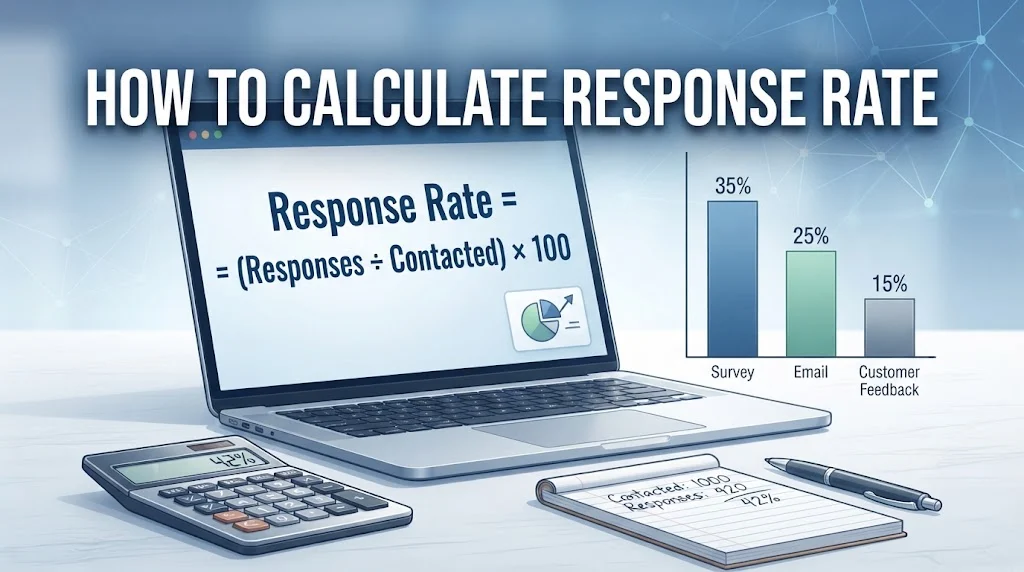
Response Rate = (Number of Responses ÷ Number of People Contacted) × 100
For example, if you send a survey to 500 people and 150 complete it, your response rate is:
(150 ÷ 500) × 100 = 30%
That is the basic version. In practice, you need to decide what counts as a “response” and who counts as “contacted.”
A partial survey completion may or may not count. A bounced email should not count in the denominator. A person who was ineligible for the survey should be excluded.
The key is consistency. Define your terms before you calculate. Then apply the same definition every time.
How to Calculate Survey Response Rate
Survey response rate is the most common use of this metric. Here is how to calculate it correctly.
Step 1: Define your eligible sample. This is the number of people who were eligible to participate. Exclude people who were ineligible, such as those who did not meet the screening criteria.
Step 2: Count completed responses. A completed response is one where the participant finished the survey. Partial responses may be counted separately or excluded, depending on your goals.
Step 3: Apply the formula.
Survey Response Rate = (Completed Responses ÷ Eligible Sample) × 100
For example, if you invited 1,000 customers to take a survey and 250 completed it, your response rate is:
(250 ÷ 1,000) × 100 = 25%
If 50 people started but did not finish, you might report a completion rate of 20% and a partial response rate of 5%. Be clear about which number you are reporting.
What about bounces and opt-outs? If an email bounced, that person never received the survey. They should not be in the denominator. If someone opted out, they are no longer eligible. Adjust your sample accordingly.
How to Calculate Email Response Rate
Email response rate is different from open rate or click-through rate. It measures how many people replied to your email.
Email Response Rate = (Number of Replies ÷ Number of Delivered Emails) × 100
Do not use the number of emails sent. Use delivered emails. If 100 emails bounced, they never reached the inbox. Counting them inflates your denominator and lowers your rate artificially.
For example, if you sent 1,000 emails and 50 bounced, you delivered 950. If 40 people replied, your response rate is:
(40 ÷ 950) × 100 = 4.2%
For cold email campaigns, the same formula applies. But you may want to track positive replies separately. A positive reply is one that expresses genuine interest, not “unsubscribe” or “not interested.”
Positive Reply Rate = (Positive Replies ÷ Delivered Emails) × 100
This gives you a clearer picture of pipeline potential.
How to Calculate Customer Service Response Rate
Customer service teams use response rate in two ways: how many customers respond to follow-up surveys, and how many support tickets get a response from the team.
For follow-up surveys, the formula is the same as survey response rate:
CSAT Response Rate = (Survey Responses ÷ Surveys Delivered) × 100
For support tickets, response rate usually means the percentage of tickets that received a reply within a certain time frame.
Ticket Response Rate = (Tickets Responded To ÷ Total Tickets) × 100
But this is more about service level than engagement. If you want to measure how many customers reply to your requests for information, use the standard formula.
How to Calculate Response Rate for Customer Feedback (NPS, CSAT)
Net Promoter Score (NPS) and Customer Satisfaction (CSAT) surveys rely on response rate to gauge reliability.
NPS Response Rate = (NPS Responses ÷ NPS Surveys Delivered) × 100
For example, if you email an NPS survey to 2,000 customers and 400 respond, your response rate is 20%.
A low NPS response rate can make your score unreliable. If only 5% of customers respond, the score may reflect the views of a vocal minority, not your customer base as a whole.
The same logic applies to CSAT. Always report the response rate alongside the score.
How to Calculate Response Rate for Market Research
Market research often uses more complex sampling methods. The response rate calculation may need to account for eligibility, refusals, and non-contacts.
The American Association for Public Opinion Research (AAPOR) provides standard definitions. The most common formula is:
Response Rate = (Complete Interviews ÷ (Complete Interviews + Partial Interviews + Refusals + Non-Contacts + Other Eligible)) × 100
This is more detailed than the basic formula. It ensures that people who were eligible but did not respond are counted in the denominator.
For most business and marketing purposes, the simple formula is enough. But if you are publishing research, use a recognized standard.
Common Mistakes When Calculating Response Rate
Even experienced analysts make these mistakes. Avoid them to keep your numbers accurate.
Using sent emails instead of delivered emails. Bounced emails should not count. They never reached the recipient.
Counting partial responses as complete. A partial response is not the same as a completed one. Report them separately or exclude them.
Including ineligible participants. If someone did not qualify for the survey, they should not be in the denominator.
Forgetting to subtract opt-outs. People who unsubscribed are no longer part of your contactable audience.
Mixing up response rate with open rate or click rate. These are different metrics. Response rate requires an actual reply or completion.
Not defining “response” clearly. Does a click count? Does a partial completion count? Decide before you calculate.
Ignoring nonresponse bias. A low response rate can skew your results. Always consider who did not respond and why.
Reporting a single blended number. Segment by audience, channel, or time period. A blended rate hides important patterns.
How to Improve Your Response Rate
Once you know how to calculate response rate, you will want to improve it. Here are practical steps.
Personalize your request. Use the recipient’s name and reference something specific to them.
Keep it short. Long surveys and emails get ignored. Respect the recipient’s time.
Send at the right time. Tuesday to Thursday, mid-morning, works best for most B2B audiences.
Follow up. A single reminder can significantly boost response rates.
Offer an incentive. A small reward, a chance to win something, or early access to results can motivate participation.
Test your subject lines. A compelling subject line increases open rates, which drives response rates.
Clean your list. Remove invalid addresses and inactive contacts. A clean list improves deliverability and response.
Make it easy to respond. One-click surveys, short forms, and clear calls to action reduce friction.
FAQs
What is the formula for response rate?
Response rate = (Number of responses ÷ Number of people contacted) × 100. For surveys, use completed responses divided by eligible participants. For emails, use replies divided by delivered emails.
Should I use sent emails or delivered emails in the denominator?
Use delivered emails. Bounced emails never reached the recipient, so they should not count. Using sent emails inflates the denominator and lowers your response rate artificially.
How do I calculate survey response rate?
Divide the number of completed surveys by the number of eligible people who received the survey. Multiply by 100. Exclude ineligible participants and bounces from the denominator.
What counts as a “response” in email response rate?
A response is a reply to your email. It does not include opens or clicks. For cold email, you may want to track positive replies separately from negative ones.
Why is my response rate so low?
Low response rates usually come from poor targeting, deliverability issues, or a request that is not relevant to the recipient. Check your list quality, email authentication, and message relevance.
Can response rate be over 100%?
No. Response rate cannot exceed 100% because the number of responses cannot be greater than the number of people contacted. If you see a rate over 100%, you have a calculation error.
How do I calculate NPS response rate?
Divide the number of NPS survey responses by the number of NPS surveys delivered. Multiply by 100. Report the response rate alongside the NPS score to show reliability.
What is a good response rate?
It depends on the context. for surveys, 20% to 30% is good. For cold email, 3% to 6% is average, and 8% to 12% is strong. For customer feedback, 10% to 20% is typical.
Conclusion
Knowing how to calculate response rate gives you a clear view of engagement and data quality. Use the right formula for your situation, define your terms, and avoid common mistakes. A well-calculated response rate helps you make better decisions and improve your outreach over time.
Read More Related Articles :
- 150+ Automatic Response Text Messages The Ultimate Guide to Auto Replies That Don’t Suck In 2026
- 150+ Automatic Response Outlook Messages: The Ultimate Guide to Auto Replies That Actually Work
- 130+ Best Replies For Every Email Response Time Tracking Situation In 2026

Sarah Mitchell is a blogger and writer at RespondLabs.com, turning everyday ideas into clear, engaging stories.
She enjoys exploring fresh perspectives and creating content that keeps readers curious and informed.
17 thoughts on “350+ How to Calculate Response Rate | Formula, Examples & Easy Guide In 2026”