Quick Answer
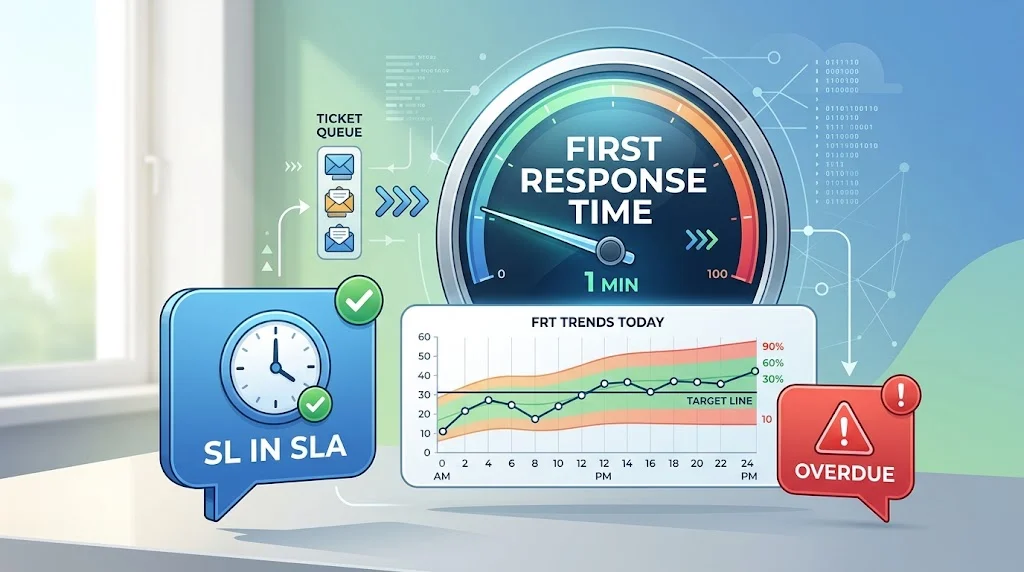
First response time (FRT) is the time between a customer’s initial message and the first meaningful reply from a support or sales team. It is calculated as total first response time divided by the number of tickets. A good target is under 1 hour for live chat and under 4 hours for email.
A customer sends a message. Then they wait. That wait is the first response time, and it shapes everything that follows.
First response time is one of the most important metrics in customer support and sales. It measures how long a customer waits before a human acknowledges their request and It is not the same as resolution time. it is not the same as average response time across all replies. It is the first meaningful contact, and it sets the tone for the entire interaction.
A fast first response tells the customer they were heard. A slow one tells them they were ignored. Research consistently shows that speed of first contact correlates with satisfaction, retention, and conversion. This article explains how to calculate first response time, what benchmarks to aim for, and how to improve it without burning out your team.
What Is First Response Time?
First response time (FRT) measures the time between when a customer submits a request and when an agent sends the first meaningful reply. It is sometimes called first reply time or first contact time.
A “meaningful reply” is not an automated acknowledgment. It is a human response that addresses the customer’s question, acknowledges the issue, or asks for more information. An auto-reply that says “We received your ticket” does not count.
First response time is different from resolution time. Resolution time measures how long until the issue is fully solved. FRT measures how long until the customer hears from a human. A ticket can have a fast first response and a slow resolution. Both metrics matter, but they measure different things.
First response time also differs from average response time. Average response time may include all replies in a thread. First response time is only the first one. For many teams, FRT is the more important metric because it sets the customer’s expectation for the rest of the interaction.
How to Calculate First Response Time
The formula is straightforward:
First Response Time = Total First Response Time ÷ Number of Tickets
For example, if a team handles five tickets with first response times of 10, 20, 30, 45, and 95 minutes, the total is 200 minutes. Divided by 5, the average first response time is 40 minutes.
The details matter. Here is what to include and exclude.
Start the clock when the customer submits the request. Not when the ticket enters your system. Not when it is assigned to an agent. The customer’s clock starts when they hit send.
Stop the clock at the first meaningful human reply. Not an auto-responder. Not a chatbot. A human response that addresses the request.
Exclude spam and duplicate tickets. These should not count in the denominator.
Decide on business hours vs calendar hours. A ticket received at 5 p.m. on Friday may sit until Monday. Do you count the weekend? Most support teams report FRT in business hours. Be consistent and document your choice.
Segment by channel and priority. A live chat FRT and an email FRT are not comparable. Neither is a high-priority ticket and a low-priority one.
First Response Time vs Other Support Metrics
FRT is one of several metrics that describe the customer experience. Each tells a different part of the story.
| Metric | What It Measures |
|---|---|
| First response time (FRT) | Time to first human reply |
| Average response time | Mean time across all replies |
| Resolution time | Time to fully solve the issue |
| First contact resolution (FCR) | Percentage solved on first contact |
| Customer satisfaction (CSAT) | How the customer rated the interaction |
| Ticket backlog | Number of unresolved tickets |
A fast FRT with a slow resolution time means customers hear back quickly but wait for a fix. A slow FRT with a fast resolution time means customers wait to be heard but get a quick fix once they are. Both are frustrating in different ways.
Track FRT alongside resolution time and CSAT. A fast response that does not solve the problem is not a good experience. A slow response that solves it perfectly is still a slow response.
First Response Time Benchmarks by Channel
Channel is the biggest driver of FRT expectations. Customers expect different speeds depending on how they contacted you.
| Channel | Typical First Response Time |
|---|---|
| Live chat | Under 1 minute |
| Phone | Under 2 minutes (wait time) |
| Social media | 1 to 4 hours |
| 4 to 12 hours | |
| Support ticket | 6 to 24 hours |
| Contact form | 12 to 24 hours |
These are broad ranges. Your industry, customer expectations, and support hours all affect what is realistic.
A 2023 benchmark report found that the average first response time across industries was around 12 hours for email tickets. Top performers averaged under 2 hours. Live chat consistently produces the fastest FRT because customers expect an immediate reply.
Customer expectations are rising. A survey found that 90% of customers expect an immediate response to a support question. That is not always achievable, but it shows the pressure support teams face.
First Response Time Benchmarks by Industry
Industry context matters as much as channel. A 4-hour FRT might be excellent in healthcare and mediocre in e-commerce.
E-commerce: 1 to 4 hours for email, under 1 minute for live chat. Customers expect fast answers about orders and returns.
SaaS: 2 to 8 hours for email, under 2 minutes for chat. Technical issues need quick acknowledgment.
Financial services: 4 to 12 hours for email. Compliance and security reviews slow down responses.
Healthcare: 8 to 24 hours for email. Strict regulations and sensitive data slow down responses.
Travel and hospitality: 1 to 4 hours. Customers often have time-sensitive issues.
Telecommunications: 4 to 12 hours. High ticket volume and complex issues slow down responses.
The spread reflects inbox volume, issue complexity, and regulatory constraints. Do not benchmark a healthcare FRT against an e-commerce FRT.
Why First Response Time Matters
FRT is not just a number. It directly affects customer satisfaction, retention, and business outcomes.
It sets the tone. The first reply tells the customer whether they matter. A fast, helpful response builds trust. A slow or generic one erodes it.
It correlates with satisfaction. Research consistently shows that faster first responses lead to higher CSAT scores. Customers who wait less are happier, even if the resolution takes the same amount of time.
It affects retention. Customers who wait too long may leave before you ever solve their problem. A fast first response keeps them engaged.
It impacts conversion. For sales inquiries, speed matters enormously. Responding to a lead within 5 minutes makes it 21 times more likely to qualify than waiting 30 minutes.
It reduces ticket escalation. A fast first response can resolve simple issues before they become complex ones. It also reduces the number of follow-up messages from anxious customers.
It protects your brand. Social media complaints can go viral. A fast first response can defuse a public issue before it spreads.
How to Improve First Response Time
Improving FRT is not about working faster. It is about removing bottlenecks.
Set clear targets by channel and priority. A single FRT target for all tickets is unrealistic. High-priority tickets should have faster targets than low-priority ones.
Use automation for triage. AI and rule-based routing can categorize and assign tickets instantly. This reduces the time between submission and agent pickup.
Build a knowledge base. When agents have quick access to answers, they respond faster. Self-service options also reduce ticket volume.
Use canned responses for common questions. Templates save time on repetitive inquiries. Personalize them so they do not feel robotic.
Staff adequately during peak hours. Most tickets arrive during predictable windows. Match staffing to demand.
Route by expertise. Sending tickets to the right agent the first time avoids transfers and delays.
Set up alerts for aging tickets. When a ticket approaches its FRT target, alert a supervisor. This prevents tickets from being forgotten.
Measure and review regularly. Track FRT by agent, channel, and time of day. Identify patterns and address them.
Close the loop with customers. Let them know their message was received, even if the full answer takes longer. A quick “We are looking into this” can buy time.
First Response Time in Sales
In sales, FRT measures how quickly a team responds to an inbound lead. Speed matters more here than almost anywhere else.
Research has shown that responding to a lead within 5 minutes makes it 21 times more likely to qualify than waiting 30 minutes. Yet the average B2B sales team takes hours or even days to respond.
Key metrics for sales FRT:
- Lead response time: Time from lead submission to first contact
- Speed to lead: Another term for the same metric
- Follow-up cadence: How many touches over how many days
Best practices for sales FRT:
- Automate lead routing and assignment
- Use templates for quick initial replies
- Alert reps when a high-value lead arrives
- Set response time targets and track them
- Use chatbots to acknowledge inquiries instantly
A fast first response does not guarantee a sale. But a slow one almost guarantees the lead will go elsewhere.
First Response Time in Customer Support
In customer support, FRT measures how quickly a customer hears back after submitting a ticket.
Best practices for support FRT:
- Use AI triage to categorize and route tickets
- Build a knowledge base for common questions
- Set clear SLAs by channel and priority
- Staff adequately during peak hours
- Use canned responses for repetitive inquiries
- Alert supervisors when tickets approach FRT targets
- Review FRT data weekly to spot trends
A fast FRT is not the same as a good experience. But it is the first step. Customers who wait too long for a reply may never give you the chance to solve their problem.
Common Mistakes When Tracking First Response Time
Even experienced teams make these mistakes. Avoiding them keeps your data accurate.
Counting auto-replies as first responses. An automated “We received your ticket” does not count. Only a meaningful human reply counts.
Using calendar hours instead of business hours. A ticket received at 5 p.m. on Friday may sit until Monday. Decide which clock you are using and be consistent.
Blending channels. A live chat FRT and an email FRT are not comparable. Segment your data.
Ignoring priority levels. A high-priority ticket and a low-priority one have different expectations. Track them separately.
Setting unrealistic targets. A 1-minute FRT for email support is not sustainable. Set targets based on channel and context.
Using FRT to evaluate individuals. FRT is a team metric. Using it to rank agents can encourage gaming and harm quality.
Forgetting about quality. A fast response that does not address the issue is worse than a slow one that does. Measure resolution and CSAT alongside FRT.
Not documenting your definitions. What counts as a first response? When does the clock start? Document it and apply it consistently.
Copy-Ready Template: First Response Time Report
Use this template to document and share FRT metrics consistently.
text
Report period: [Date range]
Context: [Customer support / Sales]

Total tickets: [Number]
Total first response time: [Sum in minutes]
Average first response time: [Total ÷ Tickets]
Median first response time: [Middle value]
p95 first response time: [Value below which 95% fall]
p99 first response time: [Value below which 99% fall]

Breakdown by channel:
- Channel 1: [Average / Median / p95]
- Channel 2: [Average / Median / p95]

Breakdown by priority:
- Priority 1: [Average / Median / p95]
- Priority 2: [Average / Median / p95]

Percentage within SLA: [Number]%
Notes: [Any relevant context, such as holidays or incidents]
First Response Time: Frequently Asked Questions
What is a good first response time?
It depends on the channel. For live chat, under 1 minute and for email, under 4 hours is strong and under 12 hours is typical. for support tickets, under 6 hours is good. For sales leads, under 5 minutes is ideal.
How do I calculate first response time?
Divide the total first response time by the number of tickets. Start the clock when the customer submits the request. Stop it at the first meaningful human reply. Exclude auto-replies from the calculation.
What counts as a first response?
A meaningful human reply that addresses the customer’s question or acknowledges the issue. An automated acknowledgment does not count. Neither does a chatbot message unless it resolves the inquiry.
What is the difference between first response time and resolution time?
First response time measures how long until the customer hears back. Resolution time measures how long until the issue is fully solved. A ticket can have a fast first response and a slow resolution.
Should I count business hours or calendar hours?
It depends on your audience and your SLA. For B2B support, business hours are common. For consumer-facing services, calendar hours may be more appropriate. Be consistent and document your choice.
Why is my first response time so slow?
Common causes include insufficient staffing during peak hours, poor ticket routing, lack of canned responses, and high ticket volume. Measure by channel and time of day to find the bottleneck.
Does first response time affect customer satisfaction?
Yes. Research consistently shows that faster first responses lead to higher satisfaction scores. Customers who wait less are happier, even if the resolution takes the same amount of time.
How can I improve first response time without hiring more staff?
Use automation for triage and routing. Build a knowledge base so agents can find answers faster. Use canned responses for common questions. Set up alerts for aging tickets. Route by expertise to avoid transfers.
Conclusion
First response time is more than a number. It is the customer’s first impression of your support or sales team. A fast, meaningful reply builds trust. A slow or generic one erodes it. Set clear targets by channel, measure consistently, and remove bottlenecks. When you improve first response time, you improve the entire customer experience.
Read More Related Articles :
- 350+ Cold Emails That Get Responses | Proven Templates, Tips & Examples In 2026
- 350+ How to Calculate Response Rate | Formula, Examples & Easy Guide In 2026
- 350+ Cold Email Response Rate | Benchmarks, Averages & Ways to Improve In 2026

James Wilson is a passionate blogger and writer at RespondLabs.com, sharing fresh perspectives on technology, business and everyday digital trends. His writing combines clear insights with an engaging, reader-friendly style.