Quick Answer
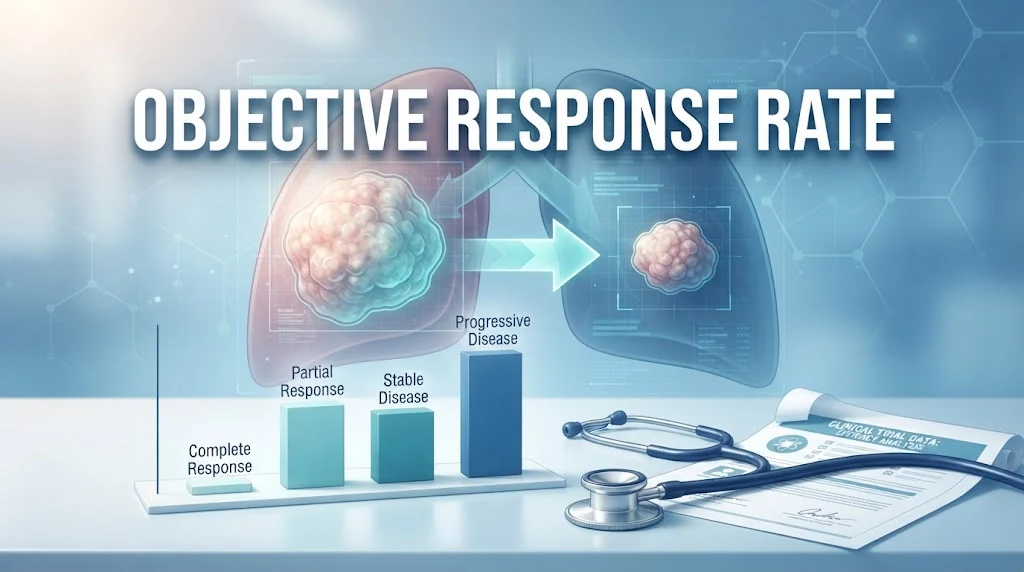
Objective response rate (ORR) is the percentage of patients whose tumor shrinks or disappears after treatment. It equals complete responses plus partial responses, divided by the total number of treated patients. ORR is a key early signal of whether a cancer drug is working.
When a new cancer drug enters clinical trials, researchers need a fast, measurable way to tell if it is doing anything. They cannot wait years for survival data. They need an early signal.
That signal is often the objective response rate. It measures how many patients see their tumors shrink or vanish after treatment. A high ORR does not guarantee a longer life, but it tells researchers the drug has biological activity. It is a reason to keep testing.
ORR appears in nearly every oncology trial report. It shapes regulatory decisions, guides trial design, and helps doctors and patients weigh treatment options. Understanding what it means, how it is calculated, and where it falls short is essential for anyone reading clinical research.
This article breaks down the objective response rate in plain language. It covers the definition, the calculation, the criteria used to measure response, and how ORR compares to other endpoints like progression-free survival and overall survival.
What Is Objective Response Rate?
Objective response rate (ORR) is the proportion of patients whose cancer shrinks or disappears after treatment. It is a standardized way to measure how well a therapy works against measurable tumors.
ORR combines two categories of response:
- Complete response (CR): The disappearance of all detectable tumor lesions.
- Partial response (PR): A significant reduction in tumor size, typically at least 30% by the longest diameter of target lesions.
The formula is simple:
ORR = (Number of patients with CR or PR) ÷ (Total number of patients treated) × 100
For example, if 100 patients receive a drug and 25 experience either a complete or partial response, the ORR is 25%.
The word “objective” is key. ORR is based on measurable changes in tumor size, not on how a patient feels or what a doctor suspects. It relies on imaging scans and standardized criteria. This makes it reproducible across trials and sites.
ORR is most commonly used in oncology, but the concept applies in other diseases where measurable lesions or biomarkers can be tracked.
The Criteria Behind Objective Response Rate: RECIST
ORR does not exist in a vacuum. It depends on a set of rules for measuring tumors. The most widely used rules are called RECIST, which stands for Response Evaluation Criteria in Solid Tumors.
RECIST was developed to standardize how researchers measure tumor response. Before RECIST, different trials used different definitions. Comparing results was nearly impossible.
RECIST defines four categories of response:
- Complete response (CR): All target lesions disappear. Any pathological lymph nodes must shrink to normal size.
- Partial response (PR): The sum of the longest diameters of target lesions decreases by at least 30% compared to baseline.
- Progressive disease (PD): The sum of the longest diameters increases by at least 20%, or new lesions appear.
- Stable disease (SD): Neither sufficient shrinkage for PR nor sufficient growth for PD.
ORR counts only CR and PR. Stable disease is not included. This is important because a drug that halts tumor growth without shrinking it may still benefit patients, but it will not show up in the ORR.
RECIST has been updated over time. RECIST 1.1 is the current standard. It refines the rules for lymph nodes, new lesions, and confirmation of response.
How Objective Response Rate Is Calculated
The calculation of ORR looks straightforward, but the details matter.
Step 1: Define the denominator. The denominator is the number of patients treated in the trial. Some trials use the intention-to-treat population, which includes everyone who was assigned to the treatment. Others use the evaluable population, which includes only patients who received treatment and had at least one post-baseline scan.
Step 2: Define the numerator. The numerator is the number of patients who achieved a confirmed complete or partial response. Most trials require confirmation, meaning the response must be observed on two consecutive scans at least four weeks apart. This reduces the risk of counting a temporary fluctuation as a response.
Step 3: Apply the formula. Divide the numerator by the denominator and multiply by 100.
Here is a simple example:
- 120 patients enrolled
- 10 patients achieved complete response
- 30 patients achieved partial response
- 40 patients achieved stable disease
- 40 patients had progressive disease
ORR = (10 + 30) ÷ 120 × 100 = 33.3%
The 40 patients with stable disease are not counted in ORR. The 40 with progressive disease are counted in the denominator but not the numerator.
The choice of denominator changes the result. If the same trial had 10 patients who dropped out before the first scan, the evaluable population would be 110. ORR would then be (40 ÷ 110) × 100 = 36.4%. This is why reading the fine print matters.
Objective Response Rate in Oncology Trials
ORR is one of the most common endpoints in early-phase oncology trials. It is used in Phase I and Phase II studies to decide whether a drug should advance to larger trials.
In Phase I trials, the primary goal is safety. But researchers also track ORR as a secondary endpoint. Even a small number of responses can justify further study.
In Phase II trials, ORR is often the primary endpoint. A drug that shows a meaningful ORR in a defined patient population may move to Phase III.
In Phase III trials, ORR is usually a secondary endpoint. The primary endpoints are typically overall survival or progression-free survival. ORR provides supportive evidence that the drug has biological activity.
ORR is also used in single-arm trials, where all patients receive the experimental treatment. In these trials, ORR can serve as the basis for accelerated approval, especially in diseases with high unmet need. The FDA and other regulators may grant approval based on a high ORR if the response is durable and the benefit outweighs the risk.
Why Objective Response Rate Matters
ORR matters for several reasons. It is fast, measurable, and directly tied to the drug’s biological effect.
It provides an early signal. Survival endpoints take years to mature. ORR can be measured within months. This allows researchers to make faster decisions about which drugs to pursue.
It guides trial design. A high ORR in Phase II supports moving to a larger, randomized trial. A low ORR may prompt researchers to change the dose, the patient population, or the drug itself.
It informs regulatory decisions. Regulatory agencies accept ORR as a basis for accelerated approval in certain settings. A durable response rate, meaning responses that last, can be enough to bring a drug to patients sooner.
It helps doctors and patients. When discussing treatment options, ORR gives a sense of how likely a tumor is to shrink. It is not a guarantee of longer life, but it is a relevant data point.
It is comparable across trials. Because ORR uses standardized criteria like RECIST, results from different trials can be compared, at least in principle. This helps the research community build a cumulative understanding of what works.
Objective Response Rate vs Other Endpoints
ORR is one of several endpoints used in oncology trials. Understanding how it compares to the others clarifies its strengths and limits.
| Endpoint | Definition | Strengths | Limitations |
|---|---|---|---|
| Objective response rate (ORR) | Percentage of patients with CR or PR | Fast, measurable, directly reflects tumor shrinkage | Does not always translate to longer survival |
| Progression-free survival (PFS) | Time from treatment to disease progression or death | Captures delay in tumor growth, more direct clinical benefit | Can be influenced by assessment timing |
| Overall survival (OS) | Time from treatment to death from any cause | Gold standard, unambiguous benefit | Takes years to mature, affected by subsequent treatments |
| Disease control rate (DCR) | Percentage with CR, PR, or SD | Captures drugs that stabilize disease | Includes stable disease, which is less robust than shrinkage |
| Duration of response (DoR) | Time from response to progression | Measures how long the benefit lasts | Only applies to responders |
ORR is not a substitute for survival. A drug can shrink tumors without extending life. A drug can also stabilize tumors, which is not counted in ORR but may still benefit patients. This is why ORR is rarely used alone. It is part of a broader picture.
Common Misconceptions About Objective Response Rate
Several misconceptions surround ORR. Clearing them up helps you read trial results more accurately.
Misconception 1: A high ORR always means a better drug. Not necessarily. A drug can shrink tumors without extending survival. The response may be temporary. What matters is whether the response translates into clinical benefit.
Misconception 2: ORR includes stable disease. No. ORR counts only complete and partial responses. Stable disease is tracked separately as the disease control rate.
Misconception 3: ORR is the same across all trials. ORR depends on the patient population, the line of therapy, and the criteria used. A 40% ORR in a first-line trial is not the same as a 40% ORR in a heavily pretreated population.
Misconception 4: ORR is a perfect surrogate for survival. It is not. The relationship between ORR and survival varies by cancer type and treatment. In some cancers, ORR correlates well with survival. In others, it does not.
Misconception 5: ORR is only used in cancer. While most common in oncology, the concept of objective response applies in other diseases where measurable lesions or biomarkers can be tracked. But the criteria and thresholds differ.
How Objective Response Rate Is Used in Practice
In clinical practice, ORR is used differently depending on the setting.
Regulatory review. The FDA and EMA may grant accelerated approval based on ORR in single-arm trials for serious conditions with unmet need. The approval is contingent on confirmatory trials showing clinical benefit.
Trial design. Researchers use ORR from early trials to set the sample size for later trials. They may also use ORR to decide which patient subgroups are most likely to benefit.
Treatment guidelines. Clinical guidelines may include ORR data when recommending treatments. A drug with a high ORR may be preferred in certain settings, especially if other options have failed.
Patient communication. Oncologists may cite ORR when discussing treatment options with patients. It helps set expectations about the likelihood of tumor shrinkage, though it is not a guarantee.
Drug development decisions. Pharmaceutical companies use ORR to decide whether to continue developing a drug. A low ORR may prompt a program to be discontinued or redirected.
Limitations of Objective Response Rate
ORR has real limitations. Ignoring them leads to overinterpretation.
It does not measure survival. Tumor shrinkage is not the same as living longer. A drug can shrink tumors but fail to extend life.
It excludes stable disease. Some drugs work by halting tumor growth rather than shrinking it. These drugs may benefit patients but show a low ORR.
It depends on measurement. ORR relies on imaging and the judgment of radiologists. Different readers may interpret scans differently.
It is affected by patient selection. A trial in healthier patients with fewer prior treatments will show a higher ORR than a trial in heavily pretreated patients. Comparing ORRs across trials requires caution.
It may not capture delayed responses. Some immunotherapies produce responses that take months to appear. Standard ORR assessment at fixed time points may miss these.
It is not always durable. A response that lasts weeks is less meaningful than one that lasts months or years. Duration of response must be reported alongside ORR.
Objective Response Rate in Immunotherapy Trials
Immunotherapies have changed how ORR is interpreted. These drugs work differently from traditional chemotherapy.
Traditional chemotherapy often shrinks tumors quickly. Immunotherapies may take longer to show an effect. Some patients experience pseudoprogression, where tumors appear to grow on scans before shrinking. Standard RECIST criteria can misclassify this as progressive disease.
To address this, researchers developed immune-related response criteria (irRC) and later iRECIST. These criteria allow for confirmation of progression and account for the delayed response patterns seen with immunotherapy.
ORR remains a key endpoint in immunotherapy trials, but it is often reported alongside durable response rate, which measures how long responses last. A 20% ORR with durable responses may be more meaningful than a 40% ORR with short-lived responses.
Frequently Asked Questions
What is a good objective response rate?
There is no universal threshold. A good ORR depends on the cancer type, the line of therapy, and the available alternatives. In some cancers, a 10% ORR is meaningful. In others, a 50% ORR may be expected. What matters is whether the ORR translates into clinical benefit.
How is objective response rate different from disease control rate?
ORR counts only complete and partial responses. Disease control rate (DCR) includes complete responses, partial responses, and stable disease. DCR captures drugs that stabilize tumors without shrinking them.
Can a drug be approved based on objective response rate alone?
Yes. Regulatory agencies like the FDA may grant accelerated approval based on a high and durable ORR in single-arm trials for serious conditions with unmet need. Full approval typically requires confirmatory trials showing clinical benefit.
Does a high ORR mean patients live longer?
Not necessarily. ORR measures tumor shrinkage, not survival. A drug can shrink tumors without extending life. Overall survival is the gold standard for clinical benefit.
What is the difference between ORR and progression-free survival?
ORR measures how many patients respond at a point in time. PFS measures how long patients live without their disease getting worse. PFS captures both responders and patients with stable disease.
How is ORR calculated in a clinical trial?
ORR = (Number of patients with confirmed complete or partial response) ÷ (Total number of patients treated) × 100. The denominator and confirmation rules vary by trial.
What is RECIST?
RECIST stands for Response Evaluation Criteria in Solid Tumors. It is a standardized set of rules for measuring tumor response in clinical trials. RECIST 1.1 is the current version.
Why does ORR exclude stable disease?
ORR is designed to measure tumor shrinkage, which is a direct sign of drug activity. Stable disease is a broader category that includes patients whose tumors neither shrink nor grow significantly. It is tracked separately as disease control rate.
Conclusion
Objective response rate is one of the most important early endpoints in oncology trials. It measures how many patients see their tumors shrink or disappear after treatment. It is fast, measurable, and standardized. But it is not a substitute for survival, and it does not capture every way a drug can help. Read ORR alongside progression-free survival, overall survival, and duration of response. Together, they tell the full story.
Read More Related Articles :
- 150+ Automatic Response Text Messages The Ultimate Guide to Auto Replies That Don’t Suck In 2026
- 150+ Automatic Response Outlook Messages: The Ultimate Guide to Auto Replies That Actually Work
- 130+ Best Replies For Every Email Response Time Tracking Situation In 2026

Robert Bennett is a passionate writer and blogger who turns everyday ideas into engaging stories and thoughtful insights.
Writing for RespondLabs.com, he brings a clear, relatable voice to topics that matter.